PlaceExploration and Early Colonization
St. Augustine
The oldest continuously occupied European-founded city in the United States
September 8, 1565St. Augustine, Florida
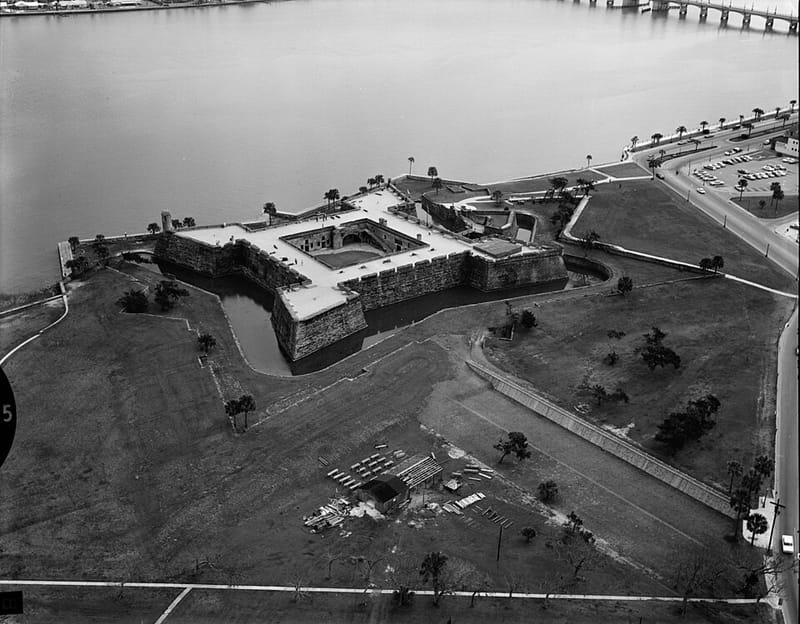
Spanish forces under Pedro Menéndez de Avilés founded St. Augustine on September 8, 1565, at the site of a Timucua village called Seloy. Built to guard the route of Spain’s treasure fleets and to drive out a French Protestant colony nearby, it began a Spanish presence in Florida that lasted, with one interruption, for more than two centuries — decades before the English reached Jamestown.
Key facts
- Date
- September 8, 1565
- Location
- St. Augustine, Florida
- Founded
- September 8, 1565, by Pedro Menéndez de Avilés
- Original site
- The Timucua village of Seloy
- First conflict
- Spanish destruction of French Fort Caroline and the killing of shipwrecked French Huguenots at Matanzas Inlet, 1565
- Landmark
- Castillo de San Marcos, a Spanish stone fort, now a national monument
Why it matters
St. Augustine is a reminder that the European colonization of what became the United States began with Spain, in the South, and that the colonial story was shaped as much by Spanish and Indigenous peoples as by the English.
About the place
St. Augustine lies on Florida’s Atlantic coast. Its historic district includes the Castillo de San Marcos, a stone fortress built by Spain and now a national monument, and the nearby Fort Matanzas. The city’s Spanish street plan and buildings make it one of the few places in the United States where the Spanish colonial era is still visible in the landscape.
History
When King Philip II of Spain learned that French Protestants (Huguenots) under René de Laudonnière had built Fort Caroline on Spanish-claimed land in Florida — a perfect base for attacks on Spanish treasure fleets — he sent General Pedro Menéndez de Avilés to remove them. Menéndez arrived in August 1565 with some 800 people and, on September 8, came ashore at the Timucua village of Seloy, naming his settlement St. Augustine.
A French fleet under Jean Ribault sailed to attack, but a hurricane wrecked it. Menéndez then captured Fort Caroline, killing most of its men. Learning from Timucua informants that shipwrecked Frenchmen were on the beach to the south, he twice met them at an inlet, accepted their surrender, and had most of them killed — 111 men in the first group and 134 in the second, including Ribault. The inlet has been called Matanzas, “slaughters,” ever since. The massacre secured Spanish control of Florida for some 235 years.
Study this entry
Check your understanding
Try answering in your own words, then open the answer.
1.What is this place?Show answerHide
St. Augustine lies on Florida’s Atlantic coast. Its historic district includes the Castillo de San Marcos, a stone fortress built by Spain and now a national monument, and the nearby Fort Matanzas.From “About the place” above.
2.What happened here?Show answerHide
When King Philip II of Spain learned that French Protestants (Huguenots) under René de Laudonnière had built Fort Caroline on Spanish-claimed land in Florida — a perfect base for attacks on Spanish treasure fleets — he sent General Pedro Menéndez de Avilés to remove them.From “History” above.
Turn this entry into 11 flashcards (key facts, dates, and why it matters) and review them in Learn.
Related History
How this connects to the rest of the atlas.
Events


Sources
- 1.The Massacre
National Park Service, Fort Matanzas National Monument · Institutional · cited for founding, Fort Caroline, Matanzas killings, Spanish control
- 2.Castillo de San Marcos — History & Culture
National Park Service, Castillo de San Marcos National Monument · Institutional · cited for the Castillo
Image credits
- Castillo de San Marcos and St. Augustine from the air, Jack E. Boucher, Historic American Buildings Survey, 1965-02. Via Wikimedia Commons · Public domain · Source
Written for American History Atlas from the sources above. See how entries are researched.
Atlas by Alexander. More on Telegram.