DocumentCivil Rights and Social Transformation
Voting Rights Act of 1965
The law that enforced the Fifteenth Amendment
August 6, 1965
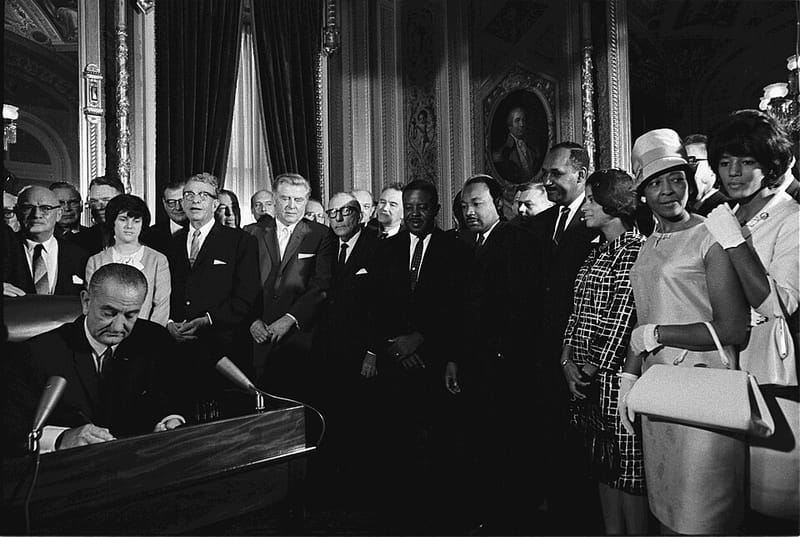
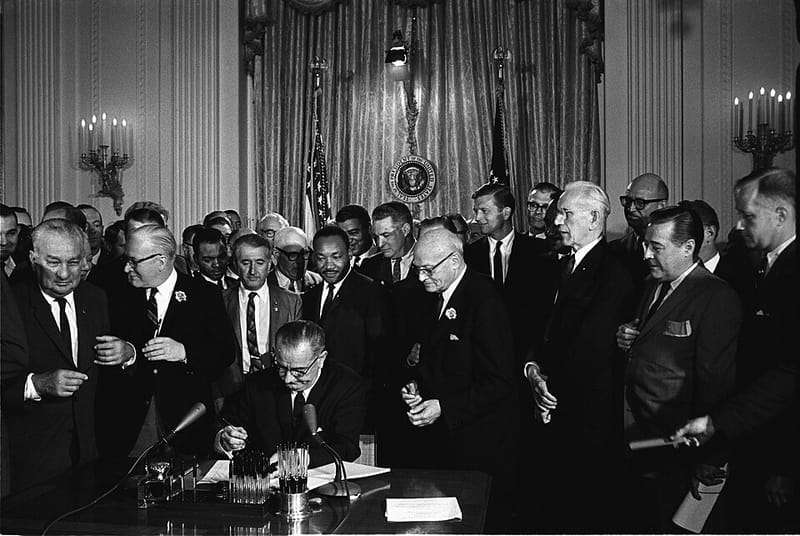
Signed by President Lyndon B. Johnson on August 6, 1965, the Voting Rights Act outlawed literacy tests and other devices used to keep Black Southerners from voting, sent federal examiners to register voters, and required certain states and localities to get federal approval before changing their voting rules. Passed after the violence at Selma, it enforced the Fifteenth Amendment 95 years after its ratification and quickly transformed Southern politics.
Key facts
- Date
- August 6, 1965
- Authors
- U.S. Congress; Lyndon B. Johnson (signed)
- Signed
- August 6, 1965
- Key provisions
- Banned literacy tests; federal examiners; Section 5 “preclearance” for covered jurisdictions; Section 2 nationwide ban on racial discrimination in voting
- Immediate impact
- A quarter of a million new Black voters registered by the end of 1965
- Renewals
- Readopted and strengthened in 1970, 1975, and 1982
- 2013
- The Supreme Court struck down a key provision of federal oversight
Read the act at the National Archives
Why it matters
The National Archives calls the Voting Rights Act the most significant change in federal–state relations over voting since Reconstruction. By the end of 1966, only four of thirteen Southern states had fewer than half of their Black citizens registered. Its scope remains contested: in 2013 the Supreme Court struck down a key provision governing federal oversight of voting rules in nine states.
Historical circumstances
Since the end of Reconstruction, Southern states had used poll taxes, literacy tests, and other restrictions, backed by harassment and violence, to keep Black citizens from voting. In Selma, Alabama, only 2 percent of Black residents were registered in early 1965. The murders of voting-rights workers in Mississippi in 1964 and the beating of marchers in Selma on March 7, 1965, drew national outrage. On March 15 Johnson told Congress, “Their cause must be our cause too … And we shall overcome,” and two days later he sent a voting rights bill. Congress passed it on August 5.
Principal ideas
Section 2, closely following the Fifteenth Amendment, prohibited denying or abridging the right to vote on account of race nationwide. The act outlawed literacy tests and authorized federal examiners to register voters in jurisdictions “covered” by a formula in the law. Section 5 required those jurisdictions to obtain “preclearance” from the Justice Department or a federal court in Washington before changing voting practices. Johnson called the vote “the most powerful instrument ever devised by man for breaking down injustice.” The Twenty-fourth Amendment had already abolished poll taxes in federal elections; in 1966 the Supreme Court struck down Virginia’s poll tax in state elections as well.
Study this entry
Check your understanding
Try answering in your own words, then open the answer.
1.Why was this document written?Show answerHide
Since the end of Reconstruction, Southern states had used poll taxes, literacy tests, and other restrictions, backed by harassment and violence, to keep Black citizens from voting. In Selma, Alabama, only 2 percent of Black residents were registered in early 1965.From “Historical circumstances” above.
2.What are its principal ideas?Show answerHide
Section 2, closely following the Fifteenth Amendment, prohibited denying or abridging the right to vote on account of race nationwide. The act outlawed literacy tests and authorized federal examiners to register voters in jurisdictions “covered” by a formula in the law.From “Principal ideas” above.
Turn this entry into 11 flashcards (key facts, dates, and why it matters) and review them in Learn.
Related History
How this connects to the rest of the atlas.
Events
People
Documents

Sources
- 1.Voting Rights Act (1965) — Milestone Documents
National Archives · Primary source · cited for provisions, impact, later decisions
- 2.Voting Rights Act of 1965
The Martin Luther King, Jr. Research and Education Institute, Stanford University · Scholarly · cited for King and the act
- 3.Selma to Montgomery March
The Martin Luther King, Jr. Research and Education Institute, Stanford University · Scholarly · cited for Bloody Sunday, march, Voting Rights Act
- 4.The American Yawp, “The Sixties”
The American Yawp (eds. Joseph Locke and Ben Wright; Stanford University Press) · Scholarly · cited for civil rights, Great Society, Vietnam, social movements
Image credits
- LyndonJohnson signs Voting Rights Act of 1965, Yoichi Okamoto, 1965-08-06. Via Wikimedia Commons · Public domain · Source
Written for American History Atlas from the sources above. See how entries are researched.
Atlas by Alexander. More on Telegram.