EventCivil Rights and Social Transformation
The Great Society
Lyndon Johnson’s program to end poverty and racial injustice, 1964–1968
May 1964 – 1968Washington, D.C., and nationwide
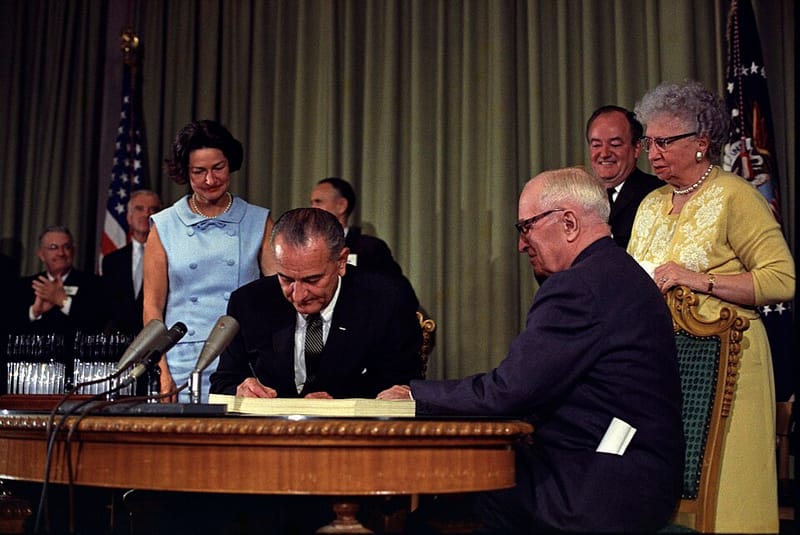
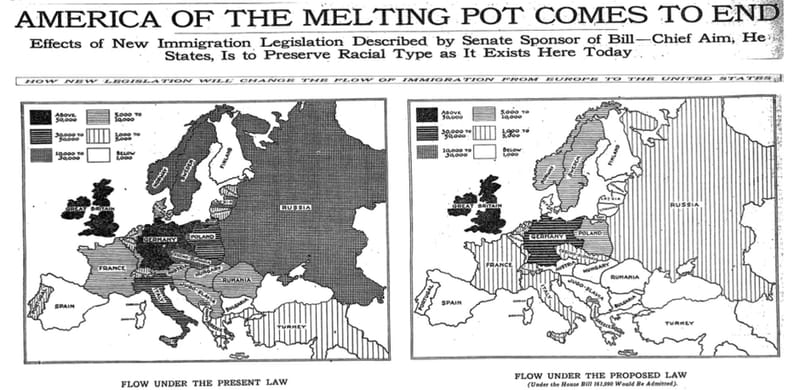
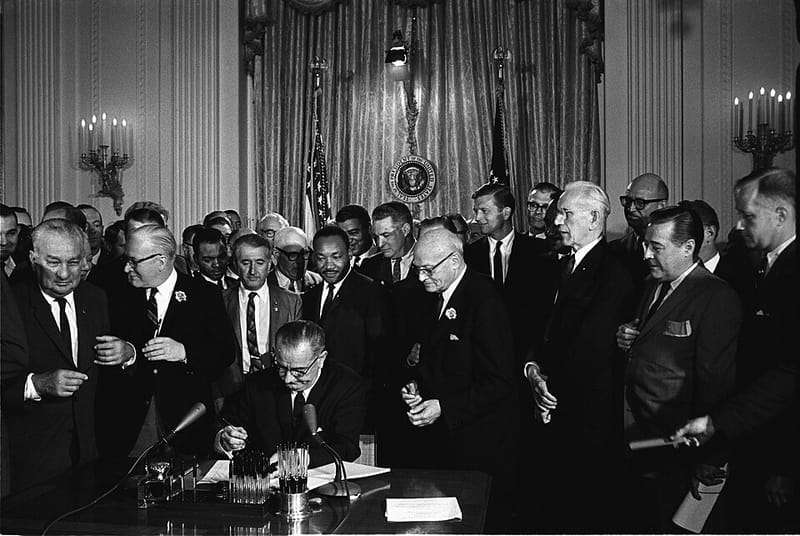
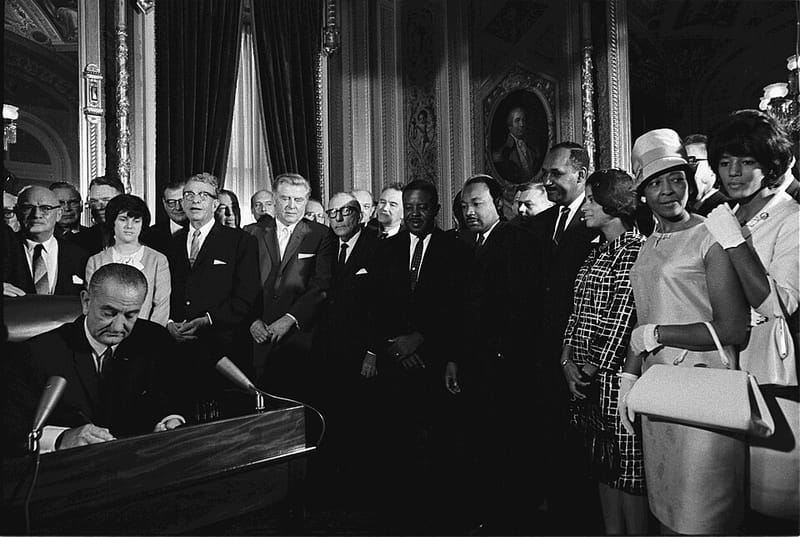
The Great Society was President Lyndon B. Johnson’s sweeping program of domestic reform. Announced in a May 1964 speech calling for “an end to poverty and racial injustice,” it produced the most ambitious burst of legislation since the New Deal: the War on Poverty, Medicare and Medicaid, federal aid to education, food stamps, the Civil Rights and Voting Rights Acts, and an immigration law that abolished the national-origins quotas of 1924. Much of it remains in place today.
Key facts
- Date
- May 1964 – 1968
- Location
- Washington, D.C., and nationwide
- Announced
- May 1964, commencement speech at the University of Michigan
- War on Poverty
- Economic Opportunity Act of 1964; about $3 billion; Community Action Programs; Head Start
- Health
- Medicare and Medicaid
- Education
- Elementary and Secondary Education Act of 1965, more than $1 billion
- Immigration
- Immigration and Nationality Act of 1965 (Hart-Celler) abolished the 1924 quota system
Why it matters
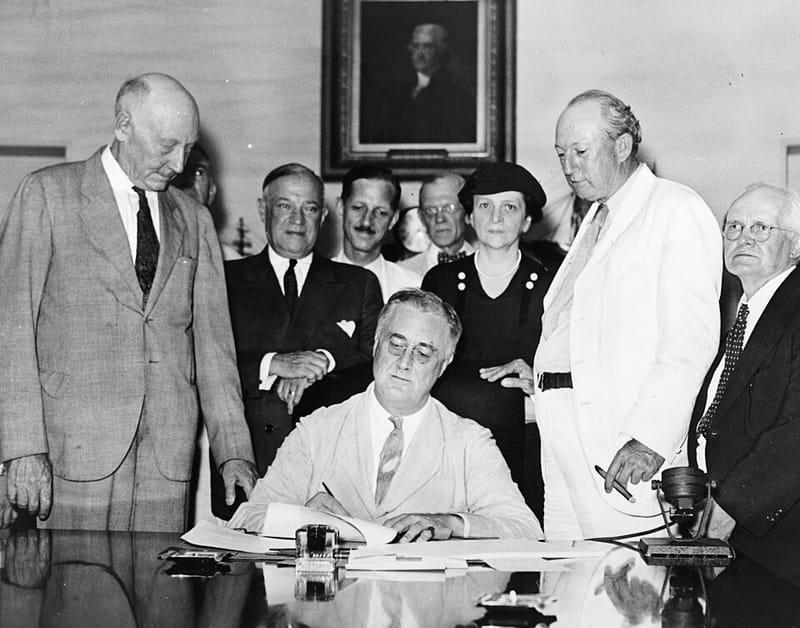
The Great Society expanded the federal government’s responsibility for health, education, and poverty more than any reform program since the New Deal.
Historical background
In an age of postwar affluence, poverty persisted in cities and rural areas, and Jim Crow still ruled the South. After John F. Kennedy’s assassination in November 1963, Johnson asked Congress to honor Kennedy’s memory by passing his tax cut and civil rights bill — and then set out his own, larger agenda. He won election in his own right by a landslide in 1964.
Causes and contributing factors
Johnson, shaped by the New Deal and by his own family’s poverty in the Texas Hill Country, believed government could abolish poverty and racial injustice in an age of affluence. Speaking at the University of Michigan in May 1964, he challenged Americans to “enrich and elevate our national life, and to advance the quality of our American civilization.”
What happened
The Economic Opportunity Act of 1964 launched the War on Poverty. Its most controversial program, Community Action, sought “maximum feasible participation” by the poor themselves in running antipoverty efforts. Congress went on to create Medicare and Medicaid to provide medical care for the elderly and the poor, the first federal food stamp program, and the Elementary and Secondary Education Act of 1965, the first major federal investment in public schools. It established the National Endowment for the Arts and the National Endowment for the Humanities. The Civil Rights Act of 1964 and Voting Rights Act of 1965 effectively ended legal Jim Crow, and the Immigration and Nationality Act of 1965 opened the country to immigrants from around the world, reshaping its population.
Immediate consequences
The War on Poverty and Community Action provoked conservative resistance and helped fuel the rise of Republicans in the South and West. The escalating Vietnam War soon overshadowed Johnson’s domestic agenda, and by 1968 his presidency was consumed by the war.
Long-term significance
Later presidents and Congresses left intact most of the Great Society — Medicare and Medicaid, food stamps, federal arts funding, and Head Start. Historians continue to debate its record: its programs kept many Americans out of poverty and secured rights for minorities, while reaction against it contributed to a conservative political counterrevolution.
Study this entry
Check your understanding
Try answering in your own words, then open the answer.
1.What led to the Great Society?Show answerHide
Johnson, shaped by the New Deal and by his own family’s poverty in the Texas Hill Country, believed government could abolish poverty and racial injustice in an age of affluence.From “Causes and contributing factors” above.
2.What happened?Show answerHide
The Economic Opportunity Act of 1964 launched the War on Poverty. Its most controversial program, Community Action, sought “maximum feasible participation” by the poor themselves in running antipoverty efforts.From “What happened” above.
3.What were the immediate consequences?Show answerHide
The War on Poverty and Community Action provoked conservative resistance and helped fuel the rise of Republicans in the South and West. The escalating Vietnam War soon overshadowed Johnson’s domestic agenda, and by 1968 his presidency was consumed by the war.From “Immediate consequences” above.
4.Why does it still matter?Show answerHide
Later presidents and Congresses left intact most of the Great Society — Medicare and Medicaid, food stamps, federal arts funding, and Head Start.From “Long-term significance” above.
Turn this entry into 11 flashcards (key facts, dates, and why it matters) and review them in Learn.
Related History
How this connects to the rest of the atlas.
People
Documents
Movements


Sources
- 1.The American Yawp, “The Sixties”
The American Yawp (eds. Joseph Locke and Ben Wright; Stanford University Press) · Scholarly · cited for civil rights, Great Society, Vietnam, social movements
- 2.Lyndon B. Johnson: Life in Brief
Miller Center, University of Virginia · Scholarly · cited for life and presidency
- 3.Lyndon B. Johnson: Impact and Legacy
Miller Center, University of Virginia · Scholarly · cited for legacy
Image credits
- Lyndon Johnson signing Medicare bill, with Harry Truman, July 30, 1965, White House Press Office, 1965-07-30. Via Wikimedia Commons · Public domain · Source
Written for American History Atlas from the sources above. See how entries are researched.
Atlas by Alexander. More on Telegram.