EventCivil Rights and Social Transformation
Selma to Montgomery Marches
“Bloody Sunday” and the march for voting rights, 1965
March 7–25, 1965Selma to Montgomery, Alabama (54 miles)
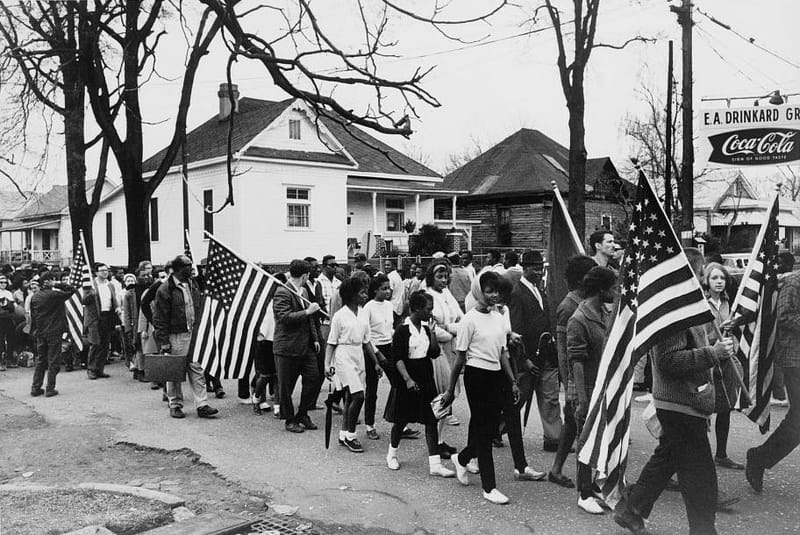
In early 1965, local activists, SNCC, and Martin Luther King Jr.’s SCLC campaigned for voting rights in Selma, Alabama, where only 2 percent of Black residents were registered. On March 7 — “Bloody Sunday” — state troopers and local lawmen attacked peaceful marchers with clubs and tear gas at the Edmund Pettus Bridge. Televised images shocked the nation. Two weeks later, under federal protection, thousands marched the 54 miles to Montgomery. The campaign led directly to the Voting Rights Act of 1965.
Key facts
- Date
- March 7–25, 1965
- Location
- Selma to Montgomery, Alabama (54 miles)
- Dating note
- Bloody Sunday, March 7; the second march to the bridge, March 9; the completed march, March 21–25, 1965.
- Bloody Sunday
- March 7, 1965, Edmund Pettus Bridge
- Leaders that day
- Hosea Williams (SCLC) and John Lewis (SNCC)
- Full march
- March 21–25, 1965; 54 miles; about 25,000 people at the end
- Deaths
- Jimmie Lee Jackson, Rev. James Reeb, Viola Liuzzo
- Result
- Voting Rights Act signed August 6, 1965
Why it matters
Selma turned the right to vote into a national cause and produced one of the most consequential laws in American history.
Historical background
On January 2, 1965, King and SCLC joined SNCC, the Dallas County Voters League, and other local activists in a voting rights campaign in Selma. SCLC chose Selma partly because they expected the brutality of Sheriff Jim Clark to attract national attention and press Congress for a voting rights law.
Causes and contributing factors
On February 18, during a night march in nearby Marion, a state trooper shot Jimmie Lee Jackson, a 26-year-old church deacon, as he tried to protect his mother; he died eight days later. Activists resolved to march from Selma to the state capitol in Montgomery.
What happened
On Sunday, March 7, marchers crossed the Edmund Pettus Bridge and met a wall of state troopers and lawmen, who ordered them to disperse and then attacked, cheered on by white onlookers. John Lewis was severely beaten. Television coverage of “Bloody Sunday” triggered national outrage.
King called on clergy nationwide to join a second march. Facing a pending federal court order, on March 9 he led more than 2,000 marchers to the bridge, stopped to pray, and turned back. That night white men attacked James Reeb, a white Unitarian minister from Massachusetts; he died two days later. On March 15 President Johnson addressed Congress, declaring, “Their cause must be our cause too.”
Federal judge Frank M. Johnson then approved the march, and on March 21 it set out, protected by federalized National Guardsmen and FBI agents. By the time it reached the capitol on March 25, the crowd had swelled to 25,000. King told them the goal was “a society at peace with itself.” That night Klansmen shot and killed Viola Liuzzo, a Michigan volunteer.
Immediate consequences
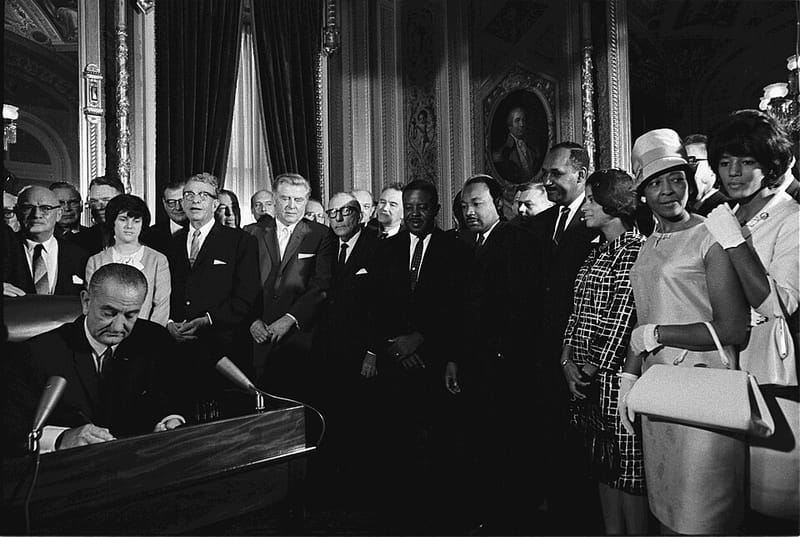
Johnson sent a voting rights bill to Congress on March 17, and he signed the Voting Rights Act on August 6, 1965, recalling “the outrage of Selma.”
Long-term significance
King summarized the movement’s legislative arc: “Montgomery led to the Civil Rights Act of 1957 and 1960; Birmingham inspired the Civil Rights Act of 1964; and Selma produced the voting rights legislation of 1965.” The Edmund Pettus Bridge remains a symbol of the struggle for the vote.
Study this entry
Check your understanding
Try answering in your own words, then open the answer.
1.What led to Selma to Montgomery Marches?Show answerHide
On February 18, during a night march in nearby Marion, a state trooper shot Jimmie Lee Jackson, a 26-year-old church deacon, as he tried to protect his mother; he died eight days later. Activists resolved to march from Selma to the state capitol in Montgomery.From “Causes and contributing factors” above.
2.What happened?Show answerHide
On Sunday, March 7, marchers crossed the Edmund Pettus Bridge and met a wall of state troopers and lawmen, who ordered them to disperse and then attacked, cheered on by white onlookers. John Lewis was severely beaten.From “What happened” above.
3.What were the immediate consequences?Show answerHide
Johnson sent a voting rights bill to Congress on March 17, and he signed the Voting Rights Act on August 6, 1965, recalling “the outrage of Selma.”From “Immediate consequences” above.
4.Why does it still matter?Show answerHide
King summarized the movement’s legislative arc: “Montgomery led to the Civil Rights Act of 1957 and 1960; Birmingham inspired the Civil Rights Act of 1964; and Selma produced the voting rights legislation of 1965.” The Edmund Pettus Bridge remains a symbol of the struggle for the vote.From “Long-term significance” above.
Turn this entry into 11 flashcards (key facts, dates, and why it matters) and review them in Learn.
Related History
How this connects to the rest of the atlas.
People

Sources
- 1.Selma to Montgomery March
The Martin Luther King, Jr. Research and Education Institute, Stanford University · Scholarly · cited for Bloody Sunday, march, Voting Rights Act
- 2.Voting Rights Act of 1965
The Martin Luther King, Jr. Research and Education Institute, Stanford University · Scholarly · cited for King and the act
- 3.Voting Rights Act (1965) — Milestone Documents
National Archives · Primary source · cited for provisions, impact, later decisions
- 4.The American Yawp, “The Sixties”
The American Yawp (eds. Joseph Locke and Ben Wright; Stanford University Press) · Scholarly · cited for civil rights, Great Society, Vietnam, social movements
Image credits
- Selma to Montgomery Marches, Peter Pettus, 1965. Via Wikimedia Commons · Public domain · Source
Written for American History Atlas from the sources above. See how entries are researched.
Atlas by Alexander. More on Telegram.