PersonIndustrialization and the Gilded Age
Sitting Bull
Hunkpapa Lakota leader who refused the reservation
c. 1831–1890
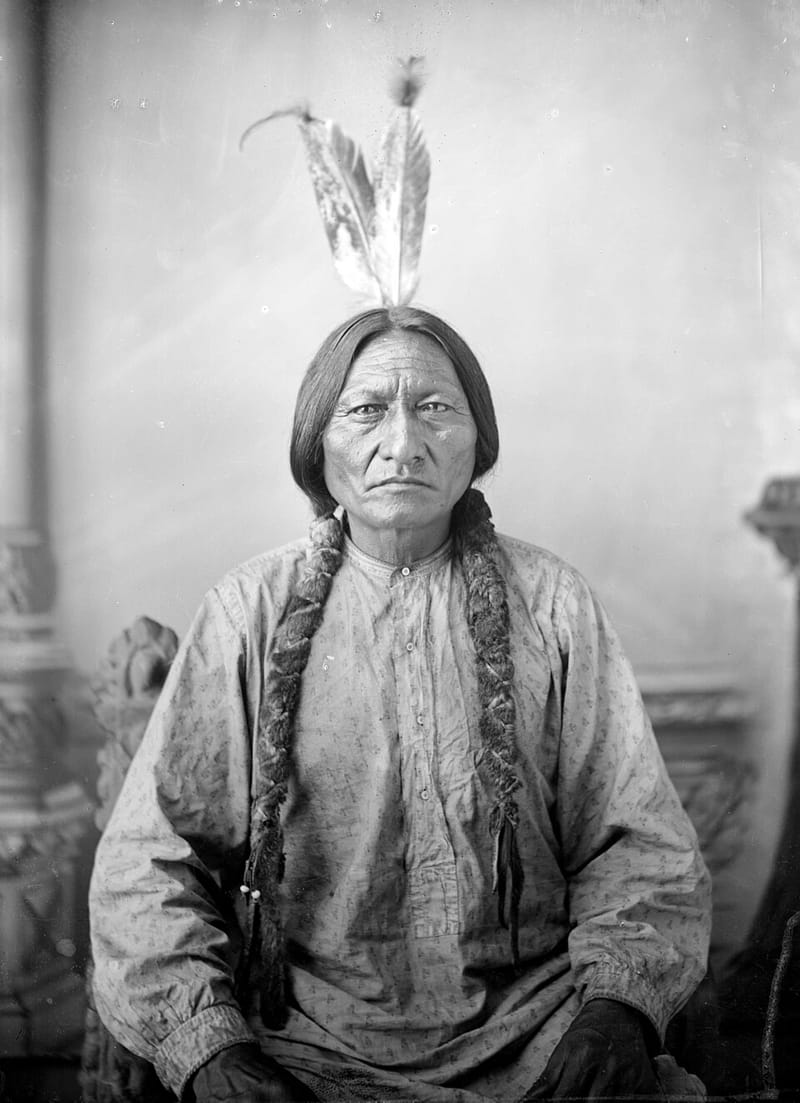
Sitting Bull (Tatanka-Iyotanka) was a Hunkpapa Lakota war leader and holy man who led the Lakota bands that refused to give up their lands and way of life for the reservation. His vision of soldiers falling into the Lakota camp like grasshoppers came weeks before the great victory over George Armstrong Custer at the Little Bighorn in 1876, which made him internationally famous. After four years of exile in Canada he surrendered in 1881, toured with Buffalo Bill’s Wild West, and was killed in 1890 by Indian police sent to arrest him amid fears of the Ghost Dance.
Key facts
- Born
- c. 1831, Near the Grand and Missouri Rivers, present-day South Dakota
- Died
- December 15, 1890, Standing Rock Reservation
- Roles
- Hunkpapa Lakota war leader; Spiritual leader; Leader of the non-treaty Lakota
- Born
- Between 1831 and 1837, to a prominent Hunkpapa family
- Known for
- Leading the non-treaty Lakota; spiritual leadership
- Surrendered
- July 20, 1881, at Fort Buford, Dakota Territory
- Died
- December 15, 1890, shot during an arrest attempt by Lakota police
Why it matters
Sitting Bull embodied the Lakota refusal to surrender their land and freedom, and his life traces the arc of the Plains wars from resistance to reservation.
Early life and context
Sitting Bull was born between 1831 and 1837 into a prominent Hunkpapa Lakota family near the confluence of the Grand and Missouri Rivers, in present-day South Dakota; his father and two uncles were chiefs. He killed his first buffalo at ten, already showing the four cardinal Lakota virtues — bravery, fortitude, generosity, and wisdom. At fourteen he counted his first coup, an honor earned in immediate proximity to the enemy, and from that day bore his father’s name, Tatanka-Iyotanka. He joined the Kit Fox and the elite Midnight Strong Heart warrior societies, became one of the Strong Hearts’ two sash wearers, and soon led the society. Through the Sun Dance and vision quests he also became known as a spiritual leader whose visions, his followers believed, came true.
Major actions and achievements
In the 1850s and 1860s, as some Lakota sought trade and diplomacy with the encroaching Americans, Sitting Bull urged them to stay apart. “I have seen nothing that the white man has… which is as good as our right to roam and live on the open plains as we choose,” he said, and he avoided white settlements and forts almost entirely until the 1880s. When Red Cloud and other leaders signed the Fort Laramie Treaty of 1868 after their war on the Bozeman Trail, Sitting Bull refused to take part, and he emerged as the leader of the “non-treaty” Lakota who kept living as they always had.
In 1876 the government declared that bands not on the reservation by January 31 would be treated as hostile. Sitting Bull ignored the deadline and sent word to the reservation that while they lived on thin rations, his people were feasting on buffalo. Many joined him for the summer hunt. At a Sun Dance in June he had fifty pieces of flesh cut from each arm and went two days and nights without water; he saw soldiers on horseback falling upside down into the camp and heard a voice say, “I give these to you because they have no ears.” On June 25, Custer’s 7th Cavalry attacked the village of some 7,000 Lakota and Cheyenne on the Little Bighorn; Sitting Bull, past fighting age, sent his nephews into battle with his own medicine, and five companies under Custer’s direct command were wiped out.
Pursued by the army, he led his followers into Canada in 1877. Hunger, disease, and hard winters slowly drew them back, and on July 20, 1881, he surrendered at Fort Buford, Dakota Territory.
Beliefs and ideas
Sitting Bull believed the Lakota should keep their land, their freedom to hunt and move, and their own way of life. He held that a treaty bound only those who signed it — those who agreed at Fort Laramie, in his view, represented themselves alone. His leadership was spiritual as well as political: he sought guidance from Wakan Tanka through ceremony and vision, and his people trusted his visions.
Controversies, limits, and criticism
Sitting Bull’s refusal to compromise split the Lakota between followers of reservation leaders such as Red Cloud and Spotted Tail and the non-treaty bands. White Americans made him famous as the architect of Custer’s defeat — an image the National Park Service notes was not necessarily accurate. On the Standing Rock reservation, agents who recognized no chiefs saw his influence as a threat; Agent McLaughlin forbade him to rejoin Buffalo Bill’s show after one season and kept up a bitter feud with him for years.
Legacy
In 1885 Sitting Bull toured as the headline attraction of Buffalo Bill Cody’s Wild West, and the two became friends; Cody gave him a gray horse trained for the show. In 1890, as the Ghost Dance — which promised that if Native people gave up white ways the buffalo and the ancestors would return — spread among the Lakota, McLaughlin ordered his arrest. At dawn on December 15, 1890, more than forty Lakota policemen burst into his cabin; a crowd gathered, shooting broke out, and Sitting Bull was killed by a shot to the chest. Two weeks later the army massacred Lakota at Wounded Knee.
Study this entry
Check your understanding
Try answering in your own words, then open the answer.
1.What shaped Sitting Bull early in life?Show answerHide
Sitting Bull was born between 1831 and 1837 into a prominent Hunkpapa Lakota family near the confluence of the Grand and Missouri Rivers, in present-day South Dakota; his father and two uncles were chiefs.From “Early life and context” above.
2.What were Sitting Bull’s major achievements?Show answerHide
In the 1850s and 1860s, as some Lakota sought trade and diplomacy with the encroaching Americans, Sitting Bull urged them to stay apart.From “Major actions and achievements” above.
3.What criticism or controversy surrounds Sitting Bull?Show answerHide
Sitting Bull’s refusal to compromise split the Lakota between followers of reservation leaders such as Red Cloud and Spotted Tail and the non-treaty bands. White Americans made him famous as the architect of Custer’s defeat — an image the National Park Service notes was not necessarily accurate.From “Controversies, limits, and criticism” above.
4.How is Sitting Bull remembered?Show answerHide
In 1885 Sitting Bull toured as the headline attraction of Buffalo Bill Cody’s Wild West, and the two became friends; Cody gave him a gray horse trained for the show.From “Legacy” above.
Turn this entry into 10 flashcards (key facts, dates, and why it matters) and review them in Learn.
Related History
How this connects to the rest of the atlas.
Events

Sources
- 1.Sitting Bull
National Park Service, Little Bighorn Battlefield National Monument · Institutional · cited for life, leadership, Canada, surrender, death
- 2.Story of the Battle
National Park Service, Little Bighorn Battlefield National Monument · Institutional · cited for background, campaign, battle, aftermath
- 3.U.S. Army massacres Indians at Wounded Knee
HISTORY (A&E Networks) · Reference · cited for Ghost Dance, Sitting Bull’s death, the massacre
Image credits
- Sitting Bull by D F Barry ca 1883 Dakota Territory, David F. Barry, Photographer, Bismarck, Dakota Territory, 1884. Via Wikimedia Commons · Public domain · Source
Written for American History Atlas from the sources above. See how entries are researched.
Atlas by Alexander. More on Telegram.