EventThe Progressive Era and World War I
Prohibition
The national ban on alcohol, 1920–1933
January 17, 1920 – December 5, 1933Nationwide
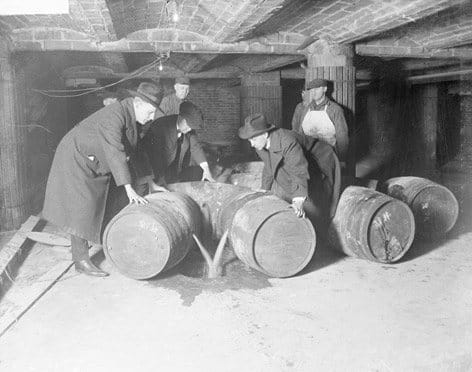
Prohibition was the nationwide ban on making, selling, and transporting alcoholic beverages, imposed by the Eighteenth Amendment and in force from January 1920 until its repeal by the Twenty-first Amendment in December 1933. The culmination of a century-long temperance crusade, it cut drinking but proved extremely hard to enforce. Bootlegging, speakeasies, and organized crime flourished, and in 1933 the Twenty-first Amendment repealed it.
Key facts
- Date
- January 17, 1920 – December 5, 1933
- Location
- Nationwide
- Dating note
- The Eighteenth Amendment was ratified January 16, 1919, and took effect one year later; the Twenty-first Amendment repealed it on December 5, 1933.
- Eighteenth Amendment
- Passed by Congress December 18, 1917; ratified January 16, 1919
- Took effect
- One year after ratification, in January 1920
- Enforcement law
- The National Prohibition Act, known as the Volstead Act
- Repeal
- Twenty-first Amendment, passed February 20, 1933; ratified December 5, 1933
- Ratification of repeal
- By state conventions, not legislatures
Why it matters
Prohibition was the high-water mark of the temperance movement and one of the most ambitious social reforms in American history — written into the Constitution and then written out of it.
Historical background
Americans had campaigned against drinking for nearly a century. The American Temperance Society was founded in 1826; the Woman’s Christian Temperance Union in 1874; and the Anti-Saloon League in 1893, which became a powerful political force. Reformers blamed alcohol for domestic abuse, poverty, crime, and disease. Women were central to the movement, seeing alcohol as a destroyer of families, and many Progressives embraced prohibition as part of their effort to improve society through government. Reformers also associated alcohol with cities and immigrants.
Causes and contributing factors
Between 1905 and 1917, many states passed laws banning the manufacture and sale of alcohol. Temperance advocates then pushed for a national ban. Congress approved the Eighteenth Amendment in December 1917, during World War I, and enough states ratified it in just thirteen months.
What happened
The amendment banned “the manufacture, sale, or transportation of intoxicating liquors” for beverage purposes, beginning one year after ratification. Congress passed the Volstead Act to enforce it.
According to the National Archives, consumption did fall: alcohol use dropped by about 30 percent, arrests for drunkenness declined, and illegal liquor became expensive. But enforcement proved extremely difficult. Bootlegging became rampant; by 1925 New York City alone had somewhere between 30,000 and 100,000 speakeasies. Neither federal nor local authorities would commit the resources needed — Maryland never passed a state enforcement law — and organized crime grew rich supplying illegal alcohol. Speakeasies also became part of the decade’s new nightlife, where young women and men mixed in ways that defied older social rules.
Immediate consequences
By the early 1930s, with the country in the Great Depression, support for Prohibition had collapsed. Congress passed the Twenty-first Amendment in February 1933, sending it to state ratifying conventions instead of legislatures, and it was ratified on December 5, 1933. The amendment returned control of alcohol to the states, some of which remained dry.
Long-term significance
Herbert Hoover called Prohibition an experiment “noble in motive and far reaching in purpose.” Its failure is often cited in debates over whether government can — or should — legislate personal behavior, including comparisons to the modern war on drugs.
Study this entry
Check your understanding
Try answering in your own words, then open the answer.
1.What led to Prohibition?Show answerHide
Between 1905 and 1917, many states passed laws banning the manufacture and sale of alcohol. Temperance advocates then pushed for a national ban.From “Causes and contributing factors” above.
2.What happened?Show answerHide
The amendment banned “the manufacture, sale, or transportation of intoxicating liquors” for beverage purposes, beginning one year after ratification. Congress passed the Volstead Act to enforce it.From “What happened” above.
3.What were the immediate consequences?Show answerHide
By the early 1930s, with the country in the Great Depression, support for Prohibition had collapsed. Congress passed the Twenty-first Amendment in February 1933, sending it to state ratifying conventions instead of legislatures, and it was ratified on December 5, 1933.From “Immediate consequences” above.
4.Why does it still matter?Show answerHide
Herbert Hoover called Prohibition an experiment “noble in motive and far reaching in purpose.” Its failure is often cited in debates over whether government can — or should — legislate personal behavior, including comparisons to the modern war on drugs.From “Long-term significance” above.
Turn this entry into 11 flashcards (key facts, dates, and why it matters) and review them in Learn.
Related History
How this connects to the rest of the atlas.
Events
Documents
.jpg)
Sources
- 1.The Constitution: Amendments 11–27
National Archives · Primary source · cited for text and dates of the 18th and 21st Amendments
- 2.18th Amendment — Prohibition of Liquor
National Constitution Center · Institutional · cited for text and dates
- 3.21st Amendment — Repeal of Prohibition
National Constitution Center · Institutional · cited for text and dates
- 4.The Volstead Act
National Archives (Educator Resources) · Institutional · cited for temperance movement, enforcement problems, consumption
- 5.Prohibition & Temperance
National Park Service · Institutional · cited for overview
- 6.The American Yawp, “The Progressive Era”
The American Yawp (eds. Joseph Locke and Ben Wright; Stanford University Press) · Scholarly · cited for Progressivism, muckrakers, Addams, Triangle fire, suffrage
- 7.The American Yawp, “The New Era”
The American Yawp (eds. Joseph Locke and Ben Wright; Stanford University Press) · Scholarly · cited for 1920s: Prohibition, immigration restriction, Klan, Great Migration
Image credits
- Prohibition agents destroying barrels of alcohol (United States, prohibition era). Via Wikimedia Commons · Public domain · Source
Written for American History Atlas from the sources above. See how entries are researched.
Atlas by Alexander. More on Telegram.