EventThe Twenties and the Great Depression
Bonnie and Clyde
Depression-era outlaws whose short, violent crime spree became an American legend
February 1932 – May 23, 1934Texas, the Southwest, and the Midwest
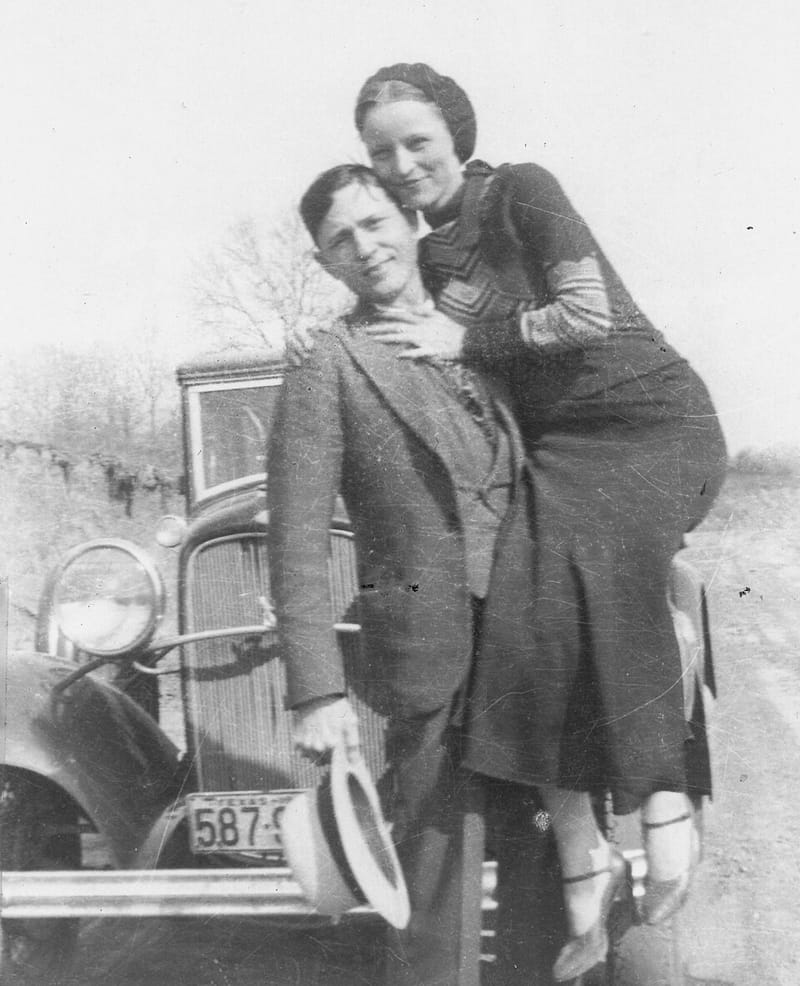
Bonnie Parker and Clyde Barrow were young Texans who, from 1932 to 1934, robbed grocery stores, filling stations, and small banks across the Southwest and Midwest and killed a number of people, several of them law officers. A posse led by former Texas Ranger Frank Hamer killed them in a roadside ambush in Louisiana on May 23, 1934. Small-time criminals in life, they became one of America’s most enduring legends — above all through the 1967 film Bonnie and Clyde.
Key facts
- Date
- February 1932 – May 23, 1934
- Location
- Texas, the Southwest, and the Midwest
- Dating note
- From Clyde Barrow’s parole in February 1932 to the ambush that killed the couple.
- Bonnie Parker
- Born October 1, 1910, in Rowena, Texas
- Clyde Barrow
- Born March 24, 1909, near Telico, Texas
- The ambush
- May 23, 1934, near Gibsland, Louisiana — the couple were killed in a barrage of 167 bullets
- Largest haul
- Only $1,500, according to the Handbook of Texas
- The film
- Bonnie and Clyde (1967), starring Warren Beatty and Faye Dunaway: ten Academy Award nominations, two wins
Why it matters
Bonnie and Clyde show how Americans turned real Depression-era violence into romantic legend — and how popular culture, especially film, can reshape the memory of history.
Historical background
Bonnie Parker grew up in “Cement City” in West Dallas after her father died in 1914. She was an honor student who liked writing poetry and reading romance novels; at four feet ten inches and eighty-five pounds, the Handbook of Texas notes, she hardly looked like a future legendary criminal. Clyde Barrow’s family moved to Dallas in 1922. He was first arrested in 1926 for stealing a car and committed a string of robberies in and around Dallas over the next four years. Their crimes unfolded during the Great Depression, and they were later compared with the era’s other famous criminals, such as John Dillinger and Al Capone.
Causes and contributing factors
Parker met Barrow in January 1930, shortly before he was jailed. She smuggled a pistol into his cell, which he used to escape; he was recaptured in Middletown, Ohio, and sentenced to fourteen years at hard labor. To avoid work on a state prison farm, he had another convict chop two toes off his left foot. In February 1932 Barrow was paroled, and he and Parker — joined at times by bank robber Raymond Hamilton, Clyde’s brother Buck, and Buck’s wife Blanche — began a series of violent holdups.
What happened
The gang robbed stores, filling stations, and small banks in Texas, Oklahoma, New Mexico, Missouri, and beyond, and killed lawmen and civilians along the way. In April 1933 police raided their hideout in Joplin, Missouri; two lawmen died, and the gang escaped but left behind film from which many of the famous photographs of the couple came. Buck Barrow was killed and Blanche captured after another shootout in Platte City, Missouri.
In January 1934 the couple attacked the Eastham Prison Farm in Texas to free Raymond Hamilton and Henry Methvin, and a guard was killed. The head of the Texas prison system and the governor then hired former Texas Ranger captain Frank Hamer to track them down. On Easter Sunday 1934 two highway patrolmen were gunned down near Grapevine, Texas, and on April 6 a constable was killed in Commerce, Oklahoma. Hamer and his officers, working with an FBI agent, found the gang through Methvin’s father’s farm near Arcadia, Louisiana, and set a roadside trap. On May 23, 1934, at 9:15 a.m., Bonnie and Clyde drove into it and were killed.
Immediate consequences
The bodies were taken to Arcadia and then to Dallas, where they were put on public display. Thousands came to see the bodies and the bullet-riddled car of the “legendary lovers,” and amid public clamor the two were buried in their families’ burial plots.
Long-term significance
Barrow and Parker were sometimes later portrayed as latter-day Robin Hoods, and their story became the basis of more than half a dozen movies. The most famous, Arthur Penn’s Bonnie and Clyde (1967), starring Warren Beatty and Faye Dunaway, caused controversy for its frank and unprecedented depiction of violence; the New York Times critic Bosley Crowther attacked it, while Newsweek’s critic publicly reversed his own negative review. The film earned ten Academy Award nominations, won two, and was later ranked among the greatest American films by the American Film Institute.
Historians stress the gap between legend and reality: despite their glamorous image, the Handbook of Texas calls them ruthless killers who showed little remorse — small-time criminals whose largest haul was only $1,500.
OrganizationsTexas prison system, Former Texas Ranger Frank Hamer’s posse, Federal Bureau of Investigation
Study this entry
Check your understanding
Try answering in your own words, then open the answer.
1.What led to Bonnie and Clyde?Show answerHide
Parker met Barrow in January 1930, shortly before he was jailed. She smuggled a pistol into his cell, which he used to escape; he was recaptured in Middletown, Ohio, and sentenced to fourteen years at hard labor.From “Causes and contributing factors” above.
2.What happened?Show answerHide
The gang robbed stores, filling stations, and small banks in Texas, Oklahoma, New Mexico, Missouri, and beyond, and killed lawmen and civilians along the way.From “What happened” above.
3.What were the immediate consequences?Show answerHide
The bodies were taken to Arcadia and then to Dallas, where they were put on public display. Thousands came to see the bodies and the bullet-riddled car of the “legendary lovers,” and amid public clamor the two were buried in their families’ burial plots.From “Immediate consequences” above.
4.Why does it still matter?Show answerHide
Barrow and Parker were sometimes later portrayed as latter-day Robin Hoods, and their story became the basis of more than half a dozen movies.From “Long-term significance” above.
Turn this entry into 11 flashcards (key facts, dates, and why it matters) and review them in Learn.
Related History
How this connects to the rest of the atlas.

Sources
- 1.Parker, Bonnie
Texas State Historical Association, Handbook of Texas · Reference · cited for Bonnie Parker’s life, the crime spree, the ambush
- 2.Barrow, Clyde Chesnut
Texas State Historical Association, Handbook of Texas · Reference · cited for Clyde Barrow’s life, the gang, the ambush, later legend
- 3.Hamer, Francis Augustus
Texas State Historical Association, Handbook of Texas · Reference · cited for Frank Hamer’s career as a Texas Ranger
- 4.Bonnie and Clyde (1967)
American Film Institute Catalog · Reference · cited for the 1967 film, its reception and awards
Image credits
- Killed in clash with Texas Rangers, Attributed to Buck Barrow, Original: 1933; This version: 23 May 193. Via Wikimedia Commons · Public domain · Source
Written for American History Atlas from the sources above. See how entries are researched.
Atlas by Alexander. More on Telegram.