EventBefore European Colonization
The Peopling of the Americas
How and when the first people arrived — a question science is still answering
c. 21,000 BCE (disputed)Beringia, the Pacific coast, and the interior of North America
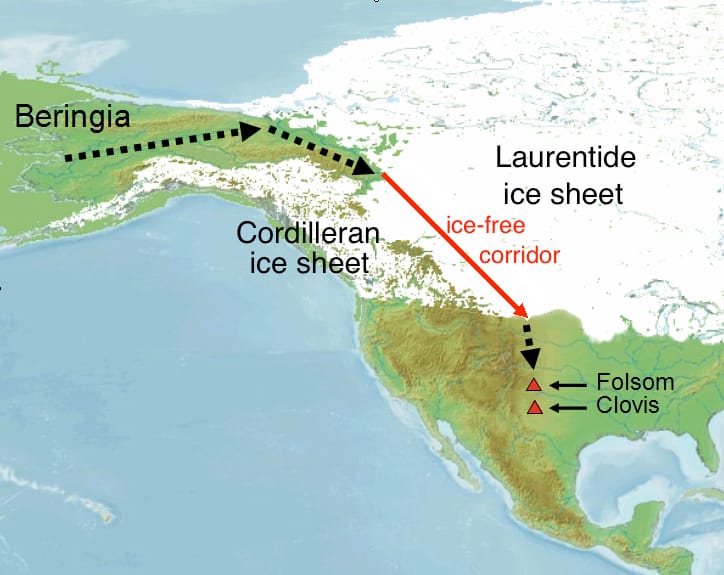
People have lived in the Americas for well over twenty thousand years. For much of the twentieth century, scientists believed the first arrivals came roughly 13,000 years ago, walking from Asia across a land bridge exposed by low Ice Age seas. Newer evidence — above all, human footprints preserved at White Sands, New Mexico, and dated to about 23,000–21,000 years ago — has pushed that date much earlier. How and when people first came remains one of the liveliest questions in archaeology.
Key facts
- Date
- c. 21,000 BCE (disputed)
- Location
- Beringia, the Pacific coast, and the interior of North America
- Dating note
- Footprints at White Sands, New Mexico, date to about 23,000–21,000 years ago; the timing and routes of the earliest arrivals remain under active research.
- Earliest firm evidence in the U.S.
- Human footprints at White Sands National Park, dated to roughly 22,860 and 21,130 years ago
- Older estimate
- About 13,500–16,000 years ago, based on stone-tool sites
- Main routes proposed
- Overland through Beringia; along the Pacific coast by boat
- Indigenous perspectives
- Many Native nations hold that their people have always lived in their homelands
Why it matters
The story of American history begins not in 1492 or 1607 but more than twenty thousand years ago, with the people whose descendants built the societies Europeans later encountered.
Historical background
During the last Ice Age, so much water was locked in glaciers that sea levels fell dramatically, exposing a broad land mass — Beringia — between Siberia and Alaska. The National Park Service’s Bering Land Bridge National Preserve protects a remnant of this landscape, across which people followed herds of large animals, many now extinct, into North America.
Causes and contributing factors
People moved for the same reasons as later migrants: to find food and survive. Over generations, small groups of hunters and gatherers spread into a continent of enormous ecological variety, adapting to tundra, forests, plains, deserts, and coasts.
What happened
For decades, the leading model held that people entered the interior around 13,000 years ago, once an ice-free corridor opened between the great glaciers, and that a distinctive stone-tool tradition called Clovis represented the first Americans. Discoveries at many sites have challenged that view, and the most dramatic evidence comes from White Sands National Park in New Mexico. There, at the edge of an ancient lake, researchers found fossilized human footprints — many apparently made by children and teenagers — in layers of sediment dated to about 23,000–21,000 years ago. The National Park Service notes that humans had previously been thought to arrive closer to 13,500–16,000 years ago.
Those dates mean people were in North America at the height of the last glacial period, when the interior route would have been blocked by ice. That has strengthened the case that some early migrants traveled along the Pacific coast, perhaps by boat, though the exact routes and timing are still debated.
Immediate consequences
Over thousands of years, the descendants of these first peoples populated both continents. They developed hundreds of languages and distinct cultures, domesticated plants such as maize, squash, and beans, and built societies ranging from small bands to cities.
Long-term significance
By the time Europeans arrived in 1492, the Americas had been home to human societies for tens of thousands of years. Recognizing that depth of time corrects the old notion of the continent as an empty “New World.” Many Native nations, whose oral traditions describe their origins in their own homelands, view migration theories as only one way of understanding their past.
Study this entry
Check your understanding
Try answering in your own words, then open the answer.
1.What led to the Peopling of the Americas?Show answerHide
People moved for the same reasons as later migrants: to find food and survive. Over generations, small groups of hunters and gatherers spread into a continent of enormous ecological variety, adapting to tundra, forests, plains, deserts, and coasts.From “Causes and contributing factors” above.
2.What happened?Show answerHide
For decades, the leading model held that people entered the interior around 13,000 years ago, once an ice-free corridor opened between the great glaciers, and that a distinctive stone-tool tradition called Clovis represented the first Americans.From “What happened” above.
3.What were the immediate consequences?Show answerHide
Over thousands of years, the descendants of these first peoples populated both continents. They developed hundreds of languages and distinct cultures, domesticated plants such as maize, squash, and beans, and built societies ranging from small bands to cities.From “Immediate consequences” above.
4.Why does it still matter?Show answerHide
By the time Europeans arrived in 1492, the Americas had been home to human societies for tens of thousands of years. Recognizing that depth of time corrects the old notion of the continent as an empty “New World.”From “Long-term significance” above.
Turn this entry into 10 flashcards (key facts, dates, and why it matters) and review them in Learn.
Related History
How this connects to the rest of the atlas.

Sources
- 1.Fossilized Footprints
National Park Service, White Sands National Park · Institutional · cited for footprint dates and earlier estimates
- 2.Bering Land Bridge — History & Culture
National Park Service, Bering Land Bridge National Preserve · Institutional · cited for migration through Beringia
Image credits
- Peopling of America through Beringia, User:Roblespepe, 2014-05-04 18:37:46. Via Wikimedia Commons · CC BY-SA 3.0 · Source
Written for American History Atlas from the sources above. See how entries are researched.
Atlas by Alexander. More on Telegram.