InstitutionBefore European Colonization
The Haudenosaunee Confederacy
The League of the Iroquois — a union of nations governed by the Great Law of Peace
c. 1450s (disputed)–presentPresent-day New York State and neighboring regions; today also Ontario and Quebec
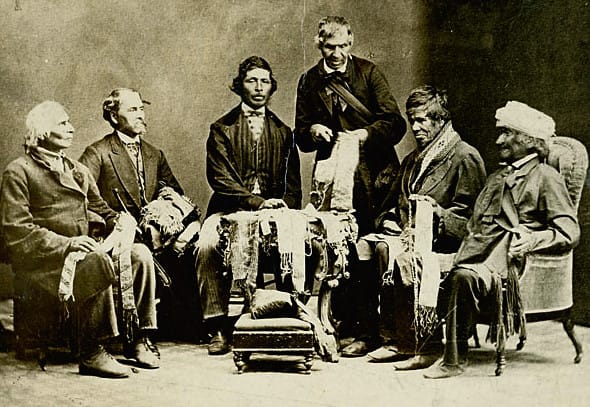
The Haudenosaunee — “People of the Longhouse” — are a confederacy of Native nations whose homelands lie mostly in present-day New York. According to their tradition, a prophet called the Peacemaker, with the help of Aionwatha (Hiawatha), persuaded five warring nations — Mohawk, Oneida, Onondaga, Cayuga, and Seneca — to accept the Great Law of Peace. The Tuscarora later joined as a sixth nation. The Confederacy still exists, making it one of the longest-lasting participatory governments in the world.
Key facts
- Date
- c. 1450s (disputed)–present
- Established
- c. 1450s (disputed)
- Location
- Present-day New York State and neighboring regions; today also Ontario and Quebec
- Dating note
- The founding date is unknown and debated; the Haudenosaunee describe the Confederacy as existing since time immemorial. Scholarly estimates range from the 1100s to the 1400s.
- Original nations
- Mohawk, Oneida, Onondaga, Cayuga, Seneca
- Sixth nation
- Tuscarora, who joined later, in the colonial era
- Grand Council
- Meets on Onondaga territory; the Onondaga are “Keepers of the Fire”
- Chiefs
- Chosen by Clan Mothers of families holding hereditary titles
- Name
- “Iroquois” was the French term; “Five” (later “Six”) Nations was the English one
Why it matters
The Haudenosaunee Confederacy is a living example of Native self-government that long predates the United States, and its diplomacy and wars shaped the colonial and revolutionary history of the Northeast.
Origins
The Haudenosaunee describe the Confederacy as founded by the Peacemaker, sent by the Creator to spread the good mind. Traveling from community to community with Aionwatha, he persuaded the chiefs of each nation to join the Great League of Peace. He asked the Clan Mothers to present their chiefs and placed deer antlers on their heads as symbols of authority. He planted a Tree of Peace — a white pine whose Great White Roots extend in the four directions to welcome any nation that accepts the Great Peace — and asked the people to bury their weapons beneath it. He bound one arrow from each nation together to show their united strength, and recorded each law of the Great Peace in strings of wampum.
The date of these events is unknown. Scholars have proposed dates ranging from the twelfth to the fifteenth century, drawing on archaeology, astronomy, and oral history; the Haudenosaunee themselves describe the Confederacy as existing since time immemorial.
Powers and limits
Each nation keeps its own council and manages its internal affairs, while the Grand Council deals with matters affecting the Confederacy as a whole. Within the metaphorical longhouse, the Mohawk, Seneca, and Onondaga sit as Elder Brothers and the Cayuga and Oneida as Younger Brothers, with the Onondaga as Keepers of the Fire. Chiefs are selected by Clan Mothers, who also hold them to their moral obligations and can remove them — a formal political role for women that European observers found striking.
How it changed over time
In the colonial era the Confederacy was a major power, controlling most of upstate New York and parts of northern Pennsylvania and balancing between the French and British empires; it allied with Britain in the French and Indian War. The American Revolution split it: the Oneida and many Tuscarora supported the Americans, while most of the other nations fought with Britain. After the war, much Haudenosaunee land was lost. The Confederacy has continued to govern and to assert its sovereignty into the present; it describes itself as still enjoying the support of the Six Nations as their representative government, even though an elective system was established in 1924.
Some writers have argued that the Great Law influenced the framers of the U.S. Constitution. Historians debate how direct any such influence was, and the claim should be treated as contested.
Study this entry
Check your understanding
Try answering in your own words, then open the answer.
1.Where did it come from?Show answerHide
The Haudenosaunee describe the Confederacy as founded by the Peacemaker, sent by the Creator to spread the good mind. Traveling from community to community with Aionwatha, he persuaded the chiefs of each nation to join the Great League of Peace.From “Origins” above.
2.What can it do, and what limits it?Show answerHide
Each nation keeps its own council and manages its internal affairs, while the Grand Council deals with matters affecting the Confederacy as a whole. Within the metaphorical longhouse, the Mohawk, Seneca, and Onondaga sit as Elder Brothers and the Cayuga and Oneida as Younger Brothers, with the Onondaga as Keepers of the Fire.From “Powers and limits” above.
3.How has it changed over time?Show answerHide
In the colonial era the Confederacy was a major power, controlling most of upstate New York and parts of northern Pennsylvania and balancing between the French and British empires; it allied with Britain in the French and Indian War.From “How it changed over time” above.
Turn this entry into 11 flashcards (key facts, dates, and why it matters) and review them in Learn.
Related History
How this connects to the rest of the atlas.
Wars

Sources
- 1.Confederacy’s Creation
Haudenosaunee Confederacy (official site) · Primary source · cited for the Peacemaker, Great Law, chiefs and Clan Mothers
- 2.Who We Are
Haudenosaunee Confederacy (official site) · Primary source · cited for member nations, longhouse roles, Grand Council
- 3.French and Indian War/Seven Years’ War, 1754–63
U.S. Department of State, Office of the Historian · Institutional · cited for Iroquois alliance with Britain
- 4.Native Americans & the American Revolution
National Archives Museum · Institutional · cited for Revolution-era divisions
Image credits
- Iroquois chiefs from the Six Nations Reserve reading wampum belts in Brantford, Ontario, Hale, Horatio (collector), 14 September 1871. Via Wikimedia Commons · Public domain · Source
Written for American History Atlas from the sources above. See how entries are researched.
Atlas by Alexander. More on Telegram.