McCulloch v. Maryland
The Supreme Court upholds broad federal power and bars states from taxing the national bank
1819Washington, D.C.
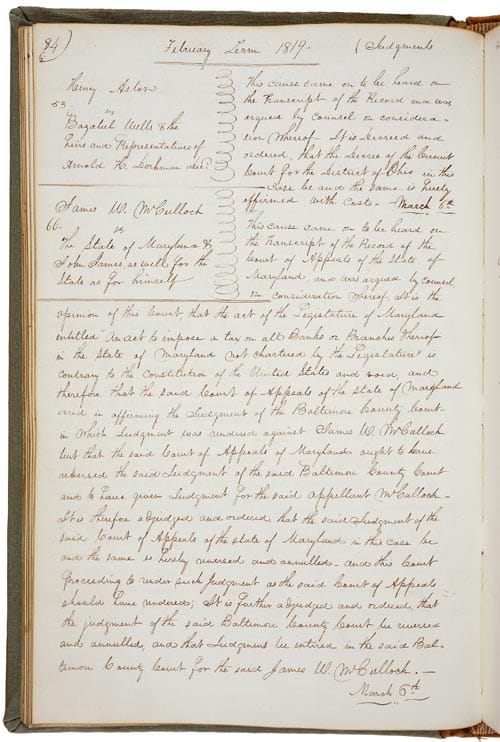
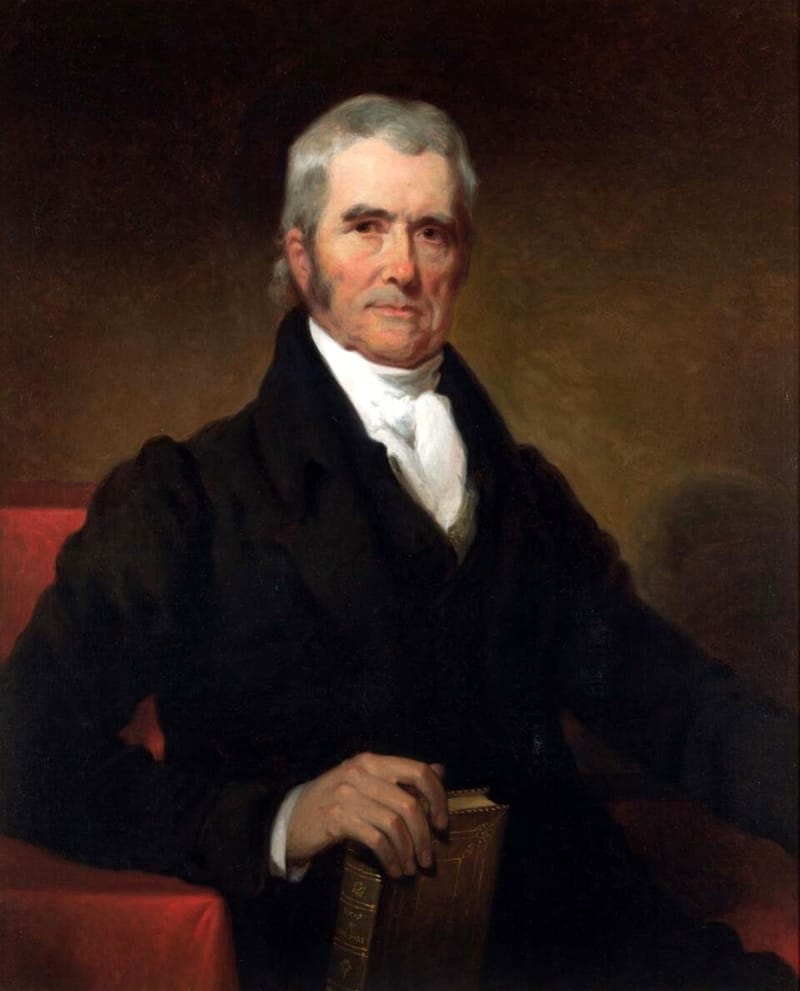
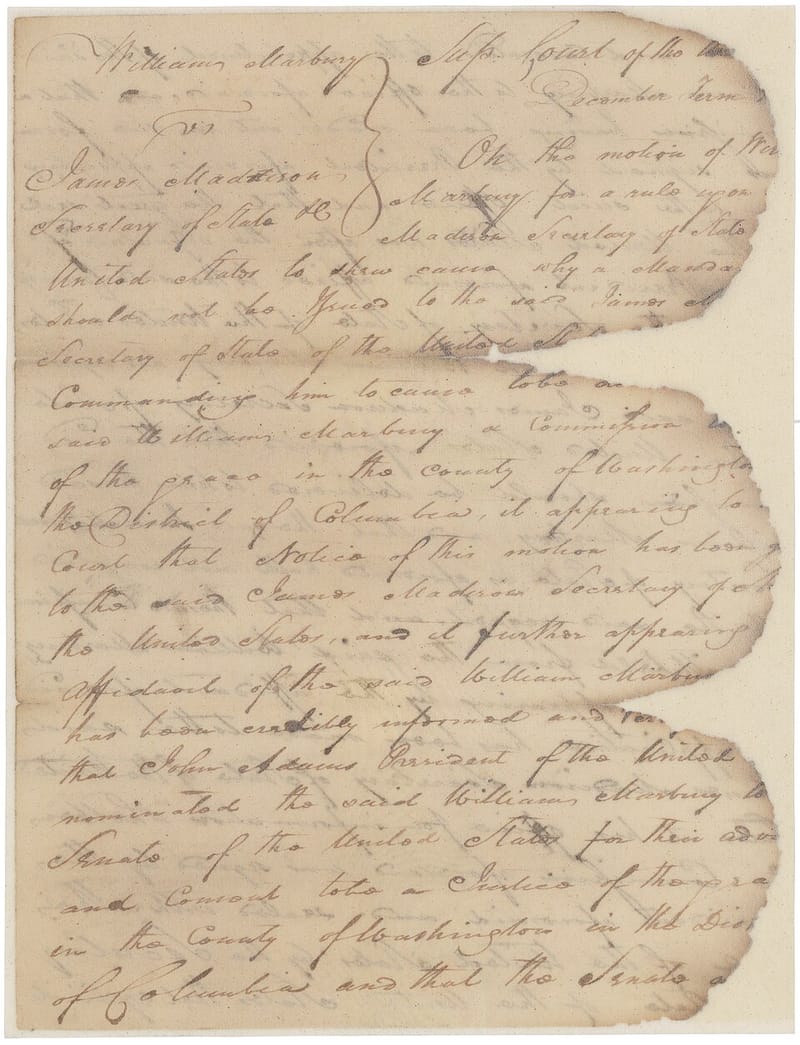
When Maryland taxed the Baltimore branch of the Second Bank of the United States, the bank’s cashier, James McCulloch, refused to pay. In 1819 the Supreme Court, speaking through Chief Justice John Marshall, ruled that Congress had the implied power to charter a bank under the Constitution’s “necessary and proper” clause, and that states could not tax the federal government — because “the power to tax involves the power to destroy.” The decision became a cornerstone of national power.
Key facts
- Citation
- 17 U.S. (4 Wheat.) 316 (1819)
- Decided
- March 6, 1819
- Vote
- Unanimous (6–0)
- Majority opinion
- Chief Justice John Marshall
- Location
- Washington, D.C.
- Parties
- James W. McCulloch, cashier of the Baltimore branch of the Second Bank of the United States, v. the State of Maryland
- Clause at issue
- The necessary and proper clause (Article I, Section 8)
- Famous lines
- “The power to tax involves the power to destroy”; “we must never forget that it is a constitution we are expounding”
Why it matters
McCulloch v. Maryland established that the federal government has powers implied by, but not listed in, the Constitution, and that federal law prevails over conflicting state action — principles at the heart of American federalism.
Historical context
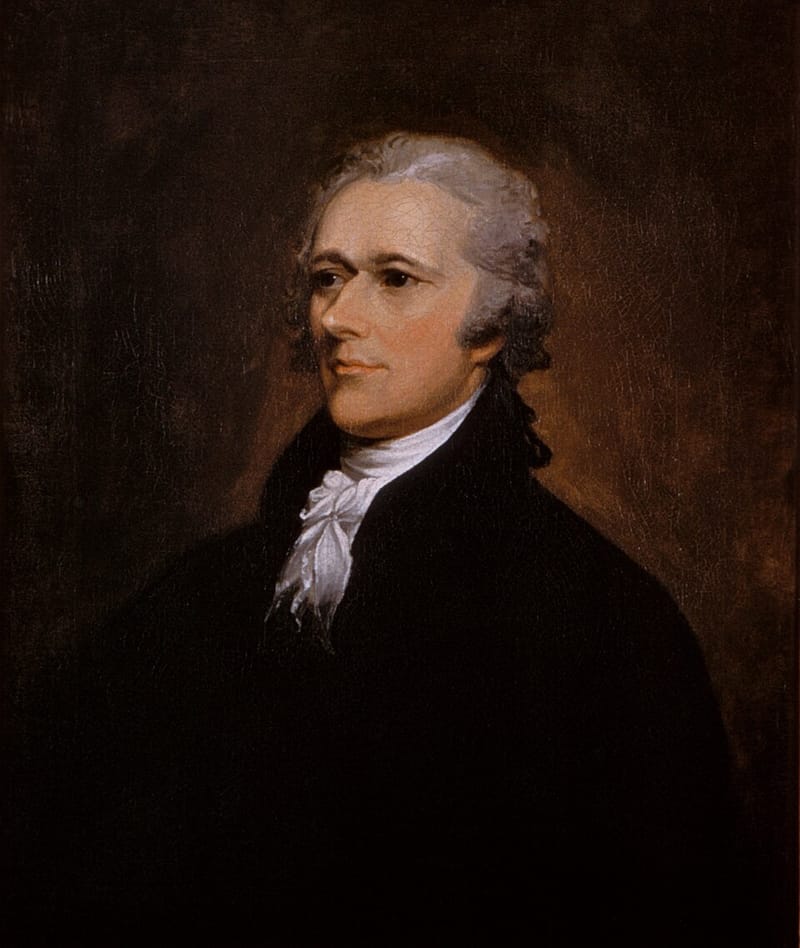
Whether Congress could create a national bank had divided the founders. In 1791 Alexander Hamilton argued that it could, as a means of carrying out its powers to tax and borrow; Jefferson and Madison argued the Constitution gave no such power. The First Bank’s charter lapsed in 1811. After the War of 1812 exposed the chaos of unregulated state banknotes, Congress chartered the Second Bank of the United States in 1816. Many states resented it, and in 1818 Maryland imposed a tax on all banks not chartered by the state — aimed squarely at the national bank’s Baltimore branch. Its cashier, James McCulloch, refused to pay, and Maryland sued.
The legal question
- Does the Constitution give Congress the power to create a bank?
- If so, may a state tax that bank?
Beneath both lay a larger question: is the federal government sovereign over the states within its sphere of authority?
The ruling
The Court unanimously held that Congress had the power to incorporate the bank, and that Maryland could not tax instruments of the national government used to carry out its constitutional powers. Maryland’s tax was unconstitutional.
The Court’s reasoning
Marshall acknowledged that the Constitution nowhere mentions a bank. But, he reasoned, a constitution cannot list every means by which government may act: “we must never forget that it is a constitution we are expounding.” The necessary and proper clause lets Congress choose any appropriate means to carry out its enumerated powers — to tax, borrow, and regulate commerce. “Necessary,” he wrote, does not mean absolutely indispensable but useful or conducive: “Let the end be legitimate, let it be within the scope of the constitution, and all means which are appropriate, which are plainly adapted to that end, which are not prohibited… are constitutional.”
On the tax, Marshall relied on the supremacy clause. The states kept their power to tax, but the Constitution and federal laws are supreme and cannot be controlled by the states. Since “the power to tax involves the power to destroy,” allowing a state to tax a federal institution would let one part of the nation undermine laws made by the whole.
Consequences
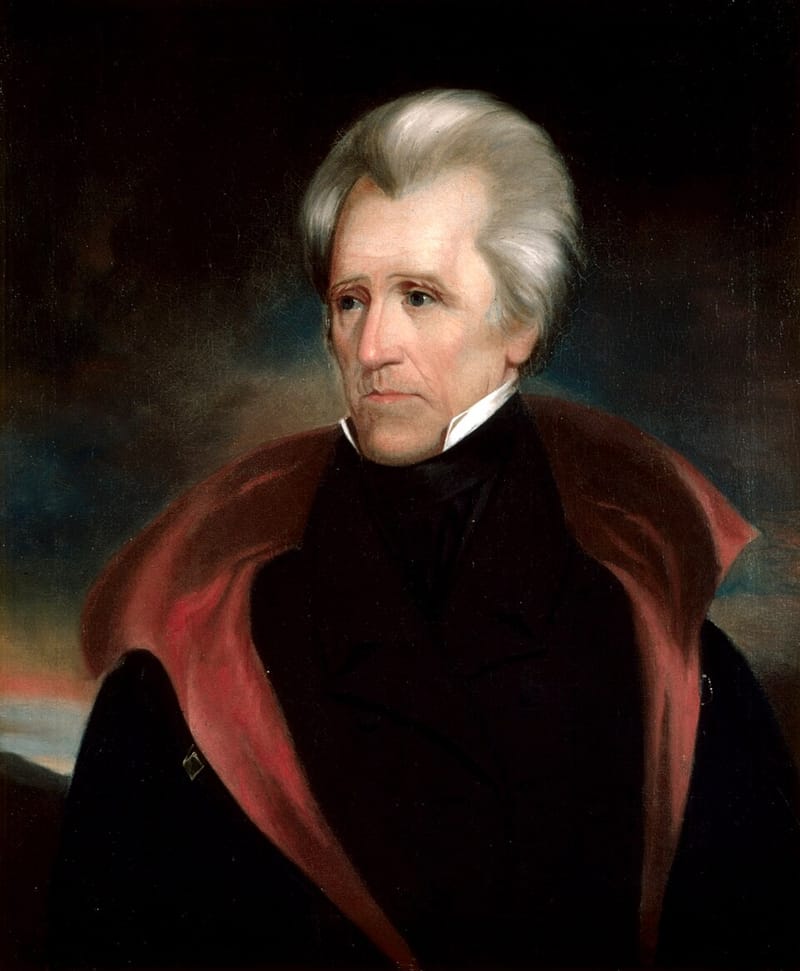
The decision secured the Second Bank until President Andrew Jackson vetoed its recharter in 1832 — arguing, in direct defiance of Marshall, that each branch must judge constitutionality for itself. More broadly, McCulloch gave Congress wide latitude to choose how to exercise its powers and confirmed that states could not interfere with legitimate federal operations.
Later interpretation
How later courts, scholars, and the public have judged the case — not part of the ruling itself.
McCulloch is regarded as one of the most important decisions in American constitutional history. Its broad reading of implied powers underpins much of modern federal law, from the regulation of the economy during the New Deal to civil rights legislation. States’-rights critics, from 1819 onward, argued that it gave the federal government nearly unlimited power. The balance between national authority and states’ rights it addressed has remained contested ever since.
Study this entry
Check your understanding
Try answering in your own words, then open the answer.
1.What question did the Court have to answer?Show answerHide
- Does the Constitution give Congress the power to create a bank? - If so, may a state tax that bank?From “The legal question” above.
2.What did the Court decide?Show answerHide
The Court unanimously held that Congress had the power to incorporate the bank, and that Maryland could not tax instruments of the national government used to carry out its constitutional powers. Maryland’s tax was unconstitutional.From “The ruling” above.
3.How did the Court justify its decision?Show answerHide
Marshall acknowledged that the Constitution nowhere mentions a bank. But, he reasoned, a constitution cannot list every means by which government may act: “we must never forget that it is a constitution we are expounding.”From “The Court’s reasoning” above.
4.What were the consequences?Show answerHide
The decision secured the Second Bank until President Andrew Jackson vetoed its recharter in 1832 — arguing, in direct defiance of Marshall, that each branch must judge constitutionality for itself.From “Consequences” above.
Turn this entry into 9 flashcards (key facts, dates, and why it matters) and review them in Learn.
Related History
How this connects to the rest of the atlas.
People

Sources
- 1.McCulloch v. Maryland (1819) — Milestone Documents
National Archives · Primary source · cited for background, questions, holding, quotations
- 2.McCulloch v. Maryland
Oyez (Cornell LII, Justia, Chicago-Kent College of Law) · Scholarly · cited for questions, holding, vote, dates
- 3.Alexander Hamilton (1789–1795)
U.S. Department of the Treasury · Institutional · cited for First Bank of the United States
Image credits
- Mccullochvmaryland. Via Wikimedia Commons · Public domain · Source
Written for American History Atlas from the sources above. See how entries are researched.
Atlas by Alexander. More on Telegram.