DocumentThe Twenties and the Great Depression
Social Security Act
The 1935 law that created old-age pensions and unemployment insurance
August 14, 1935
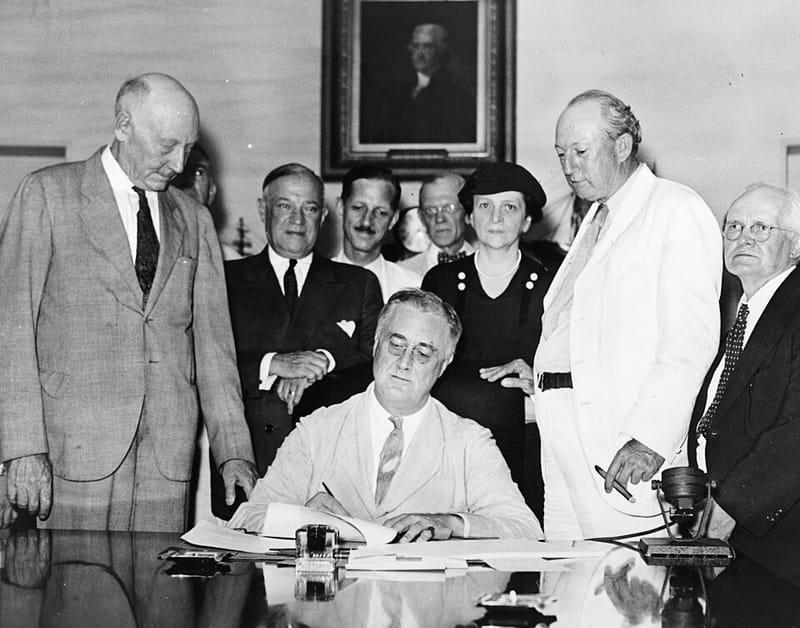
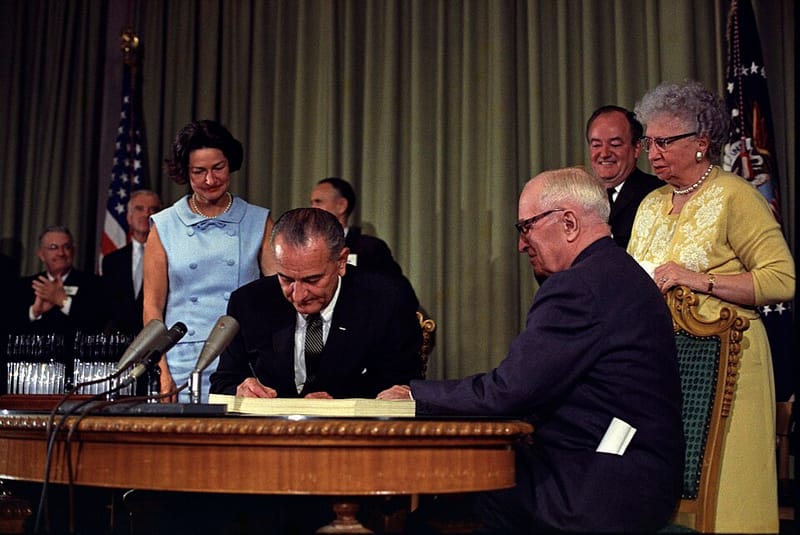
Signed by President Franklin D. Roosevelt on August 14, 1935, the Social Security Act created a national system of old-age benefits for workers, funded by taxes on wages and payrolls, along with unemployment insurance and aid to dependent children, people who are blind, and people with disabilities. It was the centerpiece of the Second New Deal and the foundation of the American safety net — though at first it excluded farm and domestic workers, a policy that disproportionately affected African Americans.
Key facts
- Date
- August 14, 1935
- Authors
- U.S. Congress; Franklin D. Roosevelt (signed)
- Signed
- August 14, 1935
- Sponsors
- Senator Robert Wagner (NY) and Representative David Lewis (MD)
- Programs
- Old-age insurance; unemployment compensation; aid to dependent children, the blind, and maternal and child health
- Financing
- Taxes on workers’ wages and employers’ payrolls
- Administered by
- The Social Security Board
Read the act at the National Archives
Why it matters
The Social Security Act established that the federal government shares responsibility for Americans’ economic security in old age and hard times. Expanded many times since, it became the centerpiece of the American social welfare state.
Historical circumstances
Before the 1930s, caring for the elderly was left to families, localities, and states; except for veterans’ pensions, Washington played no role. The Great Depression wiped out savings and jobs and built support for national old-age insurance. Movements such as Francis Townsend’s campaign for old-age pensions and Huey Long’s “Share the Wealth” campaign pressured Roosevelt from the left. On January 17, 1935, Roosevelt asked Congress for “social security” legislation. Opponents objected to government reaching into private life and to new taxes on employers, but a compromise bill passed both houses.
Principal ideas
Unlike many European systems, American old-age insurance was funded by “contributions” — taxes on individual wages and employer payrolls — rather than general government revenue. Roosevelt insisted on this design to separate Social Security from the stigma of welfare; “No dole,” he said repeatedly. The act also funded state unemployment compensation, aid to children, the blind, and the unemployed, vocational training, and public health programs.
The original law excluded agricultural and domestic workers — a concession to Southern members of Congress that left out a large share of Black workers. Roosevelt acknowledged the law’s limits, calling it “a cornerstone in a structure which is being built but is by no means complete.”
Study this entry
Check your understanding
Try answering in your own words, then open the answer.
1.Why was this document written?Show answerHide
Before the 1930s, caring for the elderly was left to families, localities, and states; except for veterans’ pensions, Washington played no role. The Great Depression wiped out savings and jobs and built support for national old-age insurance.From “Historical circumstances” above.
2.What are its principal ideas?Show answerHide
Unlike many European systems, American old-age insurance was funded by “contributions” — taxes on individual wages and employer payrolls — rather than general government revenue. Roosevelt insisted on this design to separate Social Security from the stigma of welfare; “No dole,” he said repeatedly.From “Principal ideas” above.
Turn this entry into 11 flashcards (key facts, dates, and why it matters) and review them in Learn.
Related History
How this connects to the rest of the atlas.

Sources
- 1.Social Security Act (1935) — Milestone Documents
National Archives · Primary source · cited for provisions, passage, payroll financing
- 2.The American Yawp, “The Great Depression”
The American Yawp (eds. Joseph Locke and Ben Wright; Stanford University Press) · Scholarly · cited for crash, Depression, New Deal, Dust Bowl
- 3.Franklin D. Roosevelt: Life in Brief
Miller Center, University of Virginia · Scholarly · cited for life, New Deal, war leadership
- 4.Franklin D. Roosevelt: Impact and Legacy
Miller Center, University of Virginia (William E. Leuchtenburg) · Scholarly · cited for assessment of the New Deal and presidency
Image credits
- Signing Of The Social Security Act, Social Security Online, 1935-08-14. Via Wikimedia Commons · Public domain · Source
Written for American History Atlas from the sources above. See how entries are researched.
Atlas by Alexander. More on Telegram.