EventThe Progressive Era and World War I
The Wright Brothers’ First Flight
Kill Devil Hills, North Carolina, December 17, 1903: the first powered, controlled airplane flights
December 17, 1903Kill Devil Hills, near Kitty Hawk, North Carolina
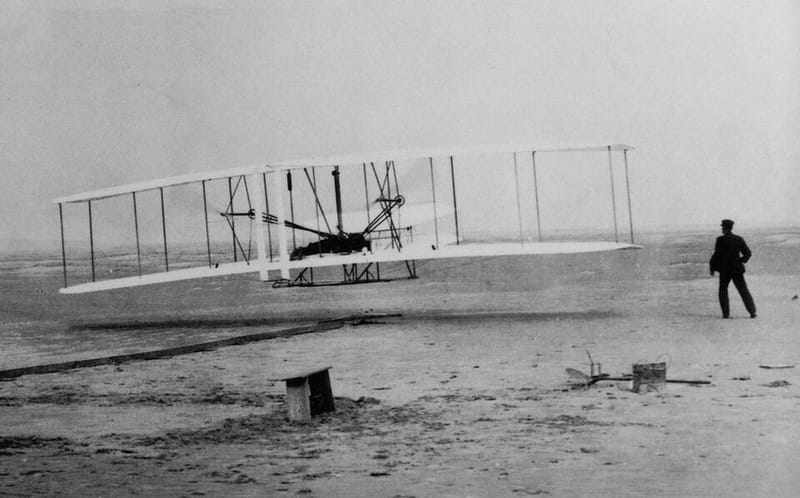
On the morning of December 17, 1903, on the windswept dunes of North Carolina’s Outer Banks, the Wright brothers’ engine-powered Wright Flyer stayed aloft for twelve seconds — the first powered, controlled flight of a heavier-than-air machine carrying a person. That day Wilbur and Orville made four flights; the longest lasted 59 seconds. Two bicycle makers from Dayton, Ohio, with no formal engineering training, they succeeded because they treated flight as a scientific problem to be solved step by step.
Key facts
- Date
- December 17, 1903
- Location
- Kill Devil Hills, near Kitty Hawk, North Carolina
- First flight
- Morning of December 17, 1903: twelve seconds aloft
- Longest flight that day
- 59 seconds, the fourth of four flights
- Engine
- A four-cylinder, 12-horsepower gasoline engine
- Witnesses
- Four men from the nearby Kill Devil Hills Lifesaving Station; one, John T. Daniels, took the first photographs of the flights
- Memorial
- Wright Brothers National Memorial, Kill Devil Hills; Congress set aside the site in 1927
Why it matters
The first flights opened the age of aviation, which within a few decades transformed war, travel, and commerce. The Wrights’ methodical, experimental approach became a model of American ingenuity.
Historical background
Wilbur and Orville Wright ran a bicycle shop in Dayton, Ohio. Tinkering with bicycles had given them a feel for all things mechanical, and when seasonal slumps hurt their sales they turned to a much bigger problem: building a flying machine. They spent years studying the principles of flight and building gliders and other prototypes. Other inventors had flown unpiloted models — Samuel P. Langley had catapulted one from a houseboat on the Potomac in 1896 — but no one had carried a person into the air under power and control.
Causes and contributing factors
The Wrights needed a place with strong, steady winds to give lift and soft sand for safe landings. After searching the East Coast, they chose the remote dunes near Kitty Hawk, on North Carolina’s Outer Banks. They first came in September 1900 to test gliders, returned in 1901 and 1902, and in 1903 brought a machine powered by a lightweight engine.
What happened
After months of setbacks, the brothers were ready on December 17, 1903. Men from the Kill Devil Hills Lifesaving Station, about a mile away, had been helping them, ferrying visitors and moving equipment; four of the crewmen came to watch. That morning the Wright Flyer rose under its own power and flew for twelve seconds. One of the lifesavers, John T. Daniels, who had volunteered to work the camera, captured the first images of the Wrights’ success. Three more flights followed that day; the fourth and longest lasted 59 seconds.
Immediate consequences
The Wrights went home to Dayton and kept testing, building more powerful models in the following years. Their achievement — study and scientific experiment, not luck, as the National Park Service stresses — solved the basic problems of powered, controlled flight. Wilbur died of typhoid fever in 1912; Orville died of a heart attack in 1948.
Long-term significance
In 1927 Congress set aside the site near Kill Devil Hill, and a tall white granite monument now stands on the hill “in commemoration of the conquest of the air”; the site is today the Wright Brothers National Memorial. The National Park Service calls their story the embodiment of “the American ideal of hard work overcoming all obstacles.” Sixty-six years after the twelve-second flight, Americans landed on the moon.
Study this entry
Check your understanding
Try answering in your own words, then open the answer.
1.What led to the Wright Brothers’ First Flight?Show answerHide
The Wrights needed a place with strong, steady winds to give lift and soft sand for safe landings. After searching the East Coast, they chose the remote dunes near Kitty Hawk, on North Carolina’s Outer Banks.From “Causes and contributing factors” above.
2.What happened?Show answerHide
After months of setbacks, the brothers were ready on December 17, 1903. Men from the Kill Devil Hills Lifesaving Station, about a mile away, had been helping them, ferrying visitors and moving equipment; four of the crewmen came to watch.From “What happened” above.
3.What were the immediate consequences?Show answerHide
The Wrights went home to Dayton and kept testing, building more powerful models in the following years. Their achievement — study and scientific experiment, not luck, as the National Park Service stresses — solved the basic problems of powered, controlled flight.From “Immediate consequences” above.
4.Why does it still matter?Show answerHide
In 1927 Congress set aside the site near Kill Devil Hill, and a tall white granite monument now stands on the hill “in commemoration of the conquest of the air”; the site is today the Wright Brothers National Memorial.From “Long-term significance” above.
Turn this entry into 10 flashcards (key facts, dates, and why it matters) and review them in Learn.
Related History
How this connects to the rest of the atlas.
Events
People

Sources
- 1.Wright Brothers National Memorial: History & Culture
National Park Service · Institutional · cited for brothers from Dayton, choice of the Outer Banks in 1900, scientific approach
- 2.Wright Brothers National Memorial
National Park Service · Institutional · cited for first flights after four years of experiment
- 3.Wright Brothers (Historical Marker B-4)
North Carolina Department of Natural and Cultural Resources · Institutional · cited for bicycle shop, choice of Kill Devil Hills, 10:53 a.m. flight, lifesavers, Daniels photograph, deaths
- 4.First Powered Flight
North Carolina Department of Natural and Cultural Resources · Institutional · cited for December 17, 1903 flight
- 5.Glimpses of Historical Areas: Kill Devil Hill Monument
National Park Service (via NPS History) · Institutional · cited for gliders 1900–1902, 12-horsepower engine, four flights, 59 seconds, Langley, 1927 memorial
Image credits
- The first flight, December 17, 1903, John T. Daniels, 1903. Via Wikimedia Commons · Public domain · Source
Written for American History Atlas from the sources above. See how entries are researched.
Atlas by Alexander. More on Telegram.