DocumentRevolution and Independence
The Federalist Papers
Eighty-five essays defending the proposed Constitution
October 1787 – May 1788New York
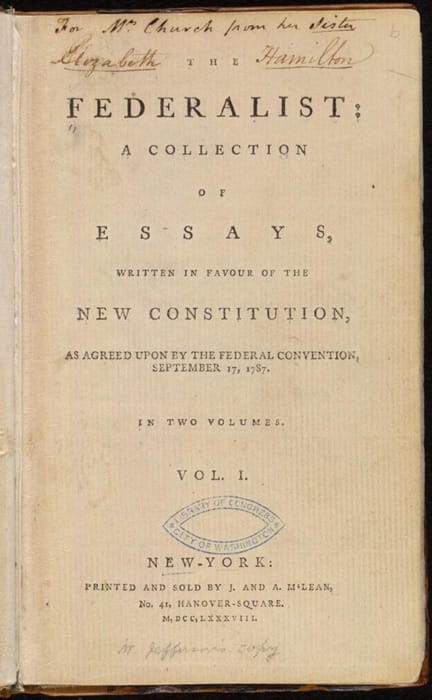
The Federalist is a series of 85 essays written in 1787–88 by Alexander Hamilton, James Madison, and John Jay, under the shared pen name “Publius,” to persuade New Yorkers to ratify the Constitution. Written fast and for a newspaper audience, the essays became the most influential explanation of how the Constitution was meant to work, and courts still cite them today.
Key facts
- Date
- October 1787 – May 1788
- Authors
- Alexander Hamilton; James Madison; John Jay; Published under the pen name “Publius”
- Location
- New York
- Dating note
- Published in New York newspapers from late 1787; collected in book form in 1788.
- Authors
- Hamilton (more than half), Madison (29), Jay (5)
- Audience
- Voters and delegates in New York, where ratification was in doubt
- Best-known essays
- No. 10 (factions), No. 51 (checks and balances), No. 78 (the judiciary)
- Opponents
- Anti-Federalist writers such as “Cato” in New York and “Centinel” in Philadelphia
Read the essays at the Avalon Project
Why it matters
Though their direct effect on ratification is debated, the Federalist essays became the classic exposition of American constitutional design. Judges, scholars, and politicians across the political spectrum still turn to them to understand the framers’ intentions.
Historical circumstances
After the Constitutional Convention sent its work to the states in September 1787, the Constitution faced strong opposition in New York, where essays signed “Cato” attacked it in the press. Hamilton enlisted John Jay and then Madison to answer. Beginning in late 1787, their essays appeared several times a week in New York newspapers and were reprinted elsewhere. Jay wrote five; Madison wrote twenty-nine between November 1787 and March 1788; Hamilton wrote the rest.
The essays were one side of a vast public debate. Anti-Federalists warned that a powerful central government would swallow the states, serve the wealthy, and threaten liberty — especially without a bill of rights.
Principal ideas
- A large republic controls faction. In No. 10, Madison defined a faction as a group “united and actuated by some common impulse of passion, or of interest,” adverse to others’ rights or the common good. Instead of removing its causes, he argued, a large republic would contain so many competing interests that no single faction could easily dominate.
- Checks and balances. In No. 51, Madison explained that each branch must have the means to resist the others: “Ambition must be made to counteract ambition.” He added: “If men were angels, no government would be necessary.”
- An energetic executive and a strong union. Hamilton argued that the nation needed a government able to raise revenue, defend itself, and act decisively.
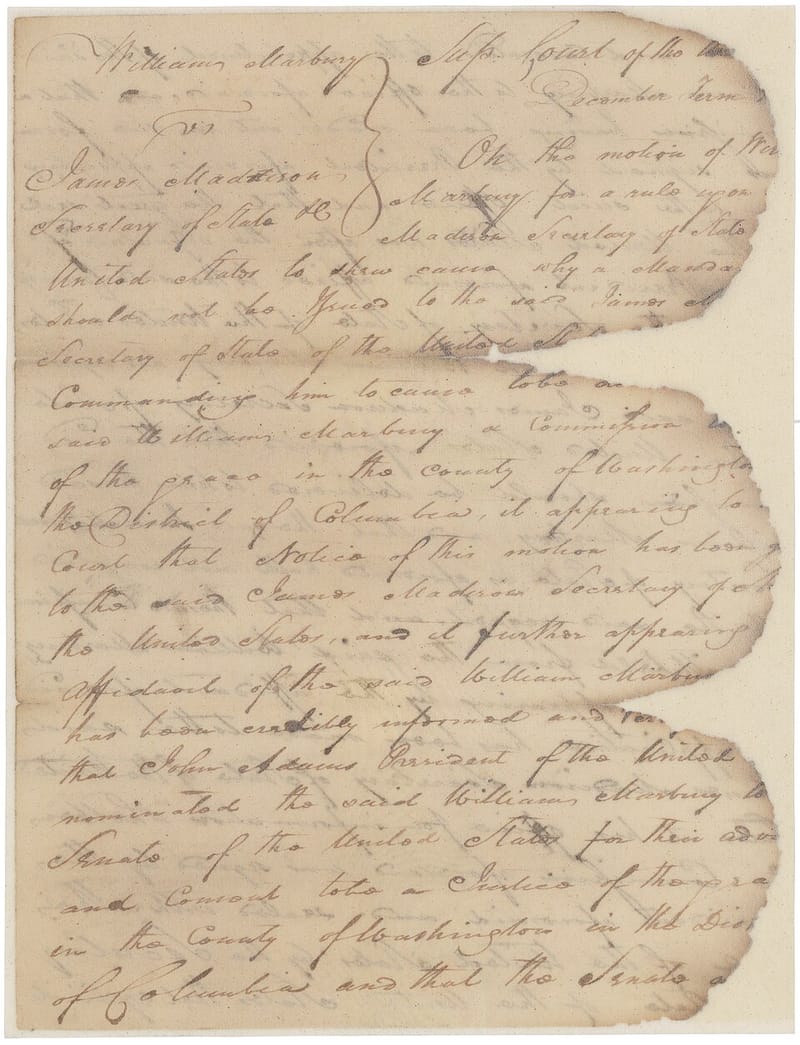
- Judicial review. In No. 78, Hamilton called the judiciary “the least dangerous” branch and argued that courts must treat the Constitution as fundamental law that prevails over ordinary statutes — reasoning later echoed in Marbury v. Madison.
- Slavery and representation. In No. 54, Madison defended counting enslaved people as three-fifths of a person for representation.
Study this entry
Check your understanding
Try answering in your own words, then open the answer.
1.Why was this document written?Show answerHide
After the Constitutional Convention sent its work to the states in September 1787, the Constitution faced strong opposition in New York, where essays signed “Cato” attacked it in the press. Hamilton enlisted John Jay and then Madison to answer.From “Historical circumstances” above.
2.What are its principal ideas?Show answerHide
- A large republic controls faction. In No. 10, Madison defined a faction as a group “united and actuated by some common impulse of passion, or of interest,” adverse to others’ rights or the common good.From “Principal ideas” above.
Turn this entry into 11 flashcards (key facts, dates, and why it matters) and review them in Learn.
Related History
How this connects to the rest of the atlas.
People
Documents
_-_02.jpg)
Sources
- 1.A More Perfect Union: The Creation of the U.S. Constitution
National Archives · Institutional · cited for convention delegates, plans, compromises, ratification
- 2.James Madison (1751–1836)
Encyclopedia Virginia, Virginia Humanities · Scholarly · cited for Madison’s 29 essays and their subjects
- 3.Alexander Hamilton
Historical Society of the New York Courts · Institutional · cited for Hamilton wrote more than half the essays
- 4.The Federalist No. 10
Avalon Project, Yale Law School · Primary source · cited for quotation
- 5.The Federalist No. 51
Avalon Project, Yale Law School · Primary source · cited for quotations
- 6.The Federalist No. 78
Avalon Project, Yale Law School · Primary source · cited for quotation
Image credits
- The Federalist (1st ed, 1788, vol I, title page) - 02, Publius (pseudonym) [ Alexander Hamilton , John Jay , James Madison ]., 1788. Via Wikimedia Commons · Public domain · Source
Written for American History Atlas from the sources above. See how entries are researched.
Atlas by Alexander. More on Telegram.