EventThe Twenties and the Great Depression
Tulsa Race Massacre
The destruction of Tulsa’s Greenwood District, 1921
May 31 – June 1, 1921Greenwood District, Tulsa, Oklahoma
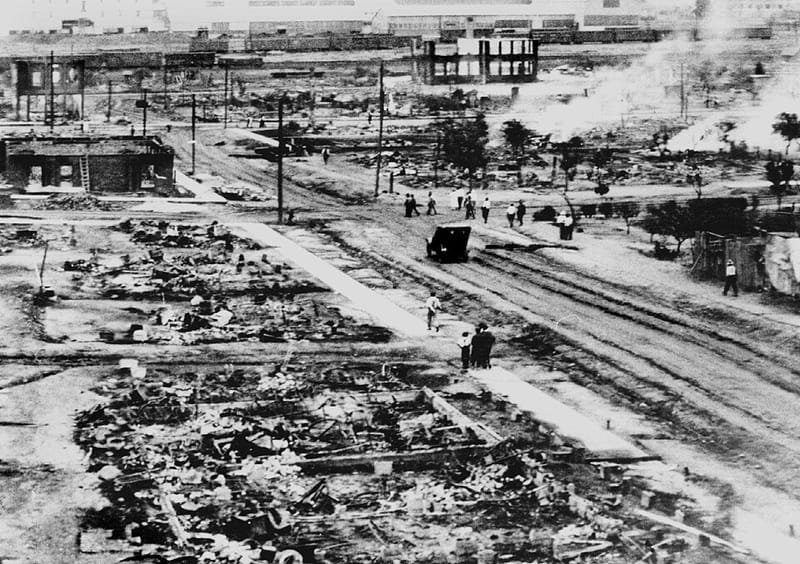
Over about eighteen hours on May 31 and June 1, 1921, white mobs attacked and burned the Greenwood District, the center of Black life in Tulsa, Oklahoma. More than a thousand homes and businesses were destroyed, and credible estimates of the dead range from fifty to three hundred. The Encyclopedia of Oklahoma History calls it the single worst incident of racial violence in American history. No white person was ever imprisoned, and the massacre was long treated as an unspoken subject.
Key facts
- Date
- May 31 – June 1, 1921
- Location
- Greenwood District, Tulsa, Oklahoma
- Dating note
- About eighteen hours of violence on May 31 and June 1, 1921.
- Dates
- May 31 – June 1, 1921
- Deaths
- Credible estimates range from 50 to 300
- Destruction
- More than 1,000 homes and businesses
- Prosecutions
- No whites were ever sent to prison
- State commission
- Formed in 1997; recommended reparations to survivors
Why it matters
The Tulsa massacre showed how white violence could destroy Black prosperity, and the long silence that followed it shows how communities and nations choose what to remember.
Historical background
By 1921 Tulsa was a booming city of more than 100,000 people. Most of its roughly 10,000 Black residents lived in Greenwood, a thriving neighborhood with two newspapers, several churches, a library branch, and scores of Black-owned businesses. It was also a time of intense racial tension, marked by the rapid growth of the second Ku Klux Klan and by Black Americans’ determined resistance to lynching. Tulsa itself had seen a white mob lynch a white teenager taken from the county jail in August 1920 while police did little to stop it.
Causes and contributing factors
On May 30, 1921, an encounter in a downtown elevator between Dick Rowland, a young Black shoe shiner, and Sarah Page, a white elevator operator, set events in motion; the most common explanation is that he stepped on her foot and she screamed. The next day the Tulsa Tribune reported that Rowland, who had been arrested, had attempted to assault Page, and eyewitnesses recalled an editorial calling for a lynching.
What happened
By evening hundreds of whites had gathered at the county courthouse demanding Rowland. Armed Black men, many of them World War I veterans, twice went to the courthouse to help protect him and were turned away by the sheriff. As the second group was leaving, a white man tried to disarm a Black veteran, a shot was fired, and fighting broke out.
Through the night, armed whites shot into Black neighborhoods and set fires along the edge of Greenwood’s business district. Police deputized members of the mob, while local National Guard units spent the night guarding a white neighborhood against a counterattack that never came. At dawn on June 1, thousands of armed whites invaded Greenwood, looting and burning homes and businesses. Black Tulsans fought to defend their community but were outnumbered and outgunned. By the time additional National Guard troops arrived that morning, most of Greenwood had been burned.
Immediate consequences
The city was placed under martial law, and thousands of Black Tulsans were held under armed guard. Most of Tulsa’s Black population was left homeless, and thousands spent the following winter in tents. Rowland was exonerated, yet an all-white grand jury blamed Black Tulsans for the violence. Despite white efforts to force the community to relocate, residents began rebuilding Greenwood within days.
Long-term significance
For decades the massacre was rarely discussed, especially in Tulsa. In 1997 Oklahoma formed a state commission to investigate; its report recommended reparations to the remaining survivors. Researchers have found evidence supporting long-held accounts that victims were buried in unmarked graves.
Study this entry
Check your understanding
Try answering in your own words, then open the answer.
1.What led to Tulsa Race Massacre?Show answerHide
On May 30, 1921, an encounter in a downtown elevator between Dick Rowland, a young Black shoe shiner, and Sarah Page, a white elevator operator, set events in motion; the most common explanation is that he stepped on her foot and she screamed.From “Causes and contributing factors” above.
2.What happened?Show answerHide
By evening hundreds of whites had gathered at the county courthouse demanding Rowland. Armed Black men, many of them World War I veterans, twice went to the courthouse to help protect him and were turned away by the sheriff.From “What happened” above.
3.What were the immediate consequences?Show answerHide
The city was placed under martial law, and thousands of Black Tulsans were held under armed guard. Most of Tulsa’s Black population was left homeless, and thousands spent the following winter in tents.From “Immediate consequences” above.
4.Why does it still matter?Show answerHide
For decades the massacre was rarely discussed, especially in Tulsa. In 1997 Oklahoma formed a state commission to investigate; its report recommended reparations to the remaining survivors.From “Long-term significance” above.
Turn this entry into 9 flashcards (key facts, dates, and why it matters) and review them in Learn.
Related History
How this connects to the rest of the atlas.
People

Sources
- 1.Tulsa Race Massacre (Scott Ellsworth)
Encyclopedia of Oklahoma History and Culture, Oklahoma Historical Society · Scholarly · cited for events, casualties, aftermath, 1997 commission
- 2.The American Yawp, “The New Era”
The American Yawp (eds. Joseph Locke and Ben Wright; Stanford University Press) · Scholarly · cited for 1920s: Prohibition, immigration restriction, Klan, Great Migration
Image credits
- Tulsa Aftermath, Unknown author Unknown author, 1921-06-01. Via Wikimedia Commons · Public domain · Source
Written for American History Atlas from the sources above. See how entries are researched.
Atlas by Alexander. More on Telegram.