PersonCivil Rights and Social Transformation
Thurgood Marshall
Civil rights lawyer and first Black justice of the Supreme Court
1908–1993
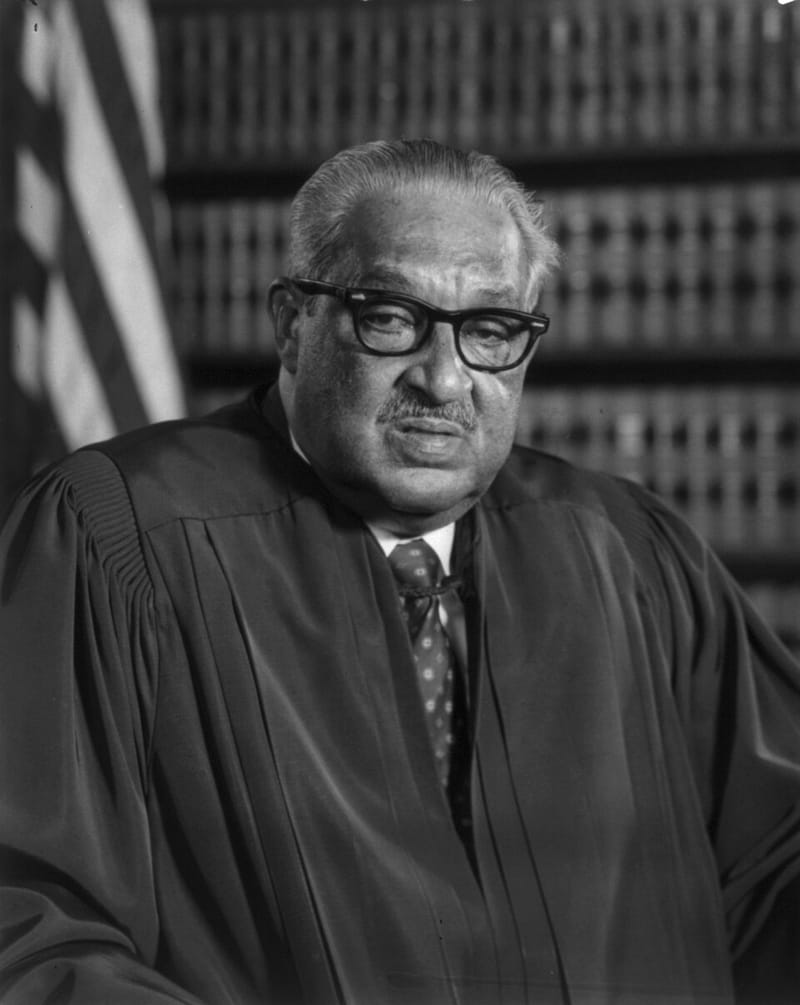
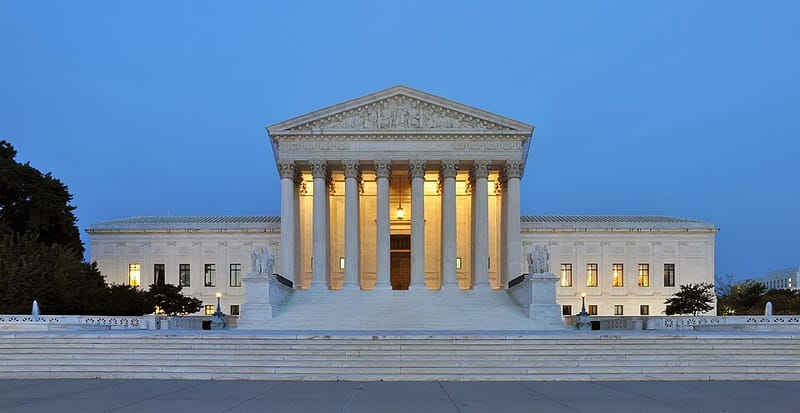
Thurgood Marshall was the lawyer who led the legal campaign against segregation and, in 1967, became the first African American justice of the Supreme Court. As chief counsel of the NAACP and director of its Legal Defense and Educational Fund, he won nearly thirty Supreme Court cases — above all Brown v. Board of Education (1954), which struck down school segregation. He then served as a federal appeals judge and as solicitor general before joining the Court, where until 1991 he was a forceful liberal voice for individual and civil rights.
Key facts
- Born
- July 2, 1908, Baltimore, Maryland
- Died
- January 24, 1993, Bethesda, Maryland
- Roles
- Chief counsel, NAACP (from 1938); Director, NAACP Legal Defense and Educational Fund (from 1940); Judge, U.S. Court of Appeals for the Second Circuit (1961); Solicitor General (1965–1967); Associate Justice of the Supreme Court (1967–1991)
- Born
- July 2, 1908, Baltimore
- Education
- Lincoln University (B.A. 1930); Howard University Law School (J.D. 1933)
- Major cases argued
- Smith v. Allwright (1944), Morgan v. Virginia (1946), Sweatt v. Painter (1950), Brown v. Board of Education (1954)
- Supreme Court
- 1967–1991; first African American justice
- Died
- January 24, 1993
Why it matters
Thurgood Marshall led the legal assault that dismantled segregation and became a pioneering figure on the nation’s highest court.
Early life and context
Marshall was born on July 2, 1908, in Baltimore, the son of a kindergarten teacher and a railroad dining-car waiter. On his days off, his father took the boys to watch trials and then made them argue legal questions at home, challenging every point. Baltimore was segregated — Marshall attended an all-Black grade school and once could not find a restroom he was allowed to use — and as punishment for misbehaving in high school he was sent to read the Constitution, which he came to know backwards and forwards. At Lincoln University in Pennsylvania, a classmate of Langston Hughes, he was suspended for hazing, then found his calling in the debate club and helped desegregate a local movie theater.
Rejected by the University of Maryland’s law school because of his race, he went to Howard University; his mother sold her wedding ring to help pay the tuition. There the assistant dean, Charles Hamilton Houston, was training a generation of civil rights lawyers to use the law itself against discrimination. Marshall graduated first in his class in 1933, turned down a scholarship to Harvard, and opened a practice in Baltimore, turning away no one who could not pay.
Major actions and achievements
One of Marshall’s first victories forced the University of Maryland’s law school — the school that had rejected him — to admit a Black student. He joined the NAACP’s national staff, succeeded Houston as its chief counsel in 1938, and from 1940 directed the new NAACP Legal Defense and Educational Fund. He traveled through the South investigating lynchings and the denial of voting rights and fair trials, often at personal risk. In the Supreme Court he won Smith v. Allwright (1944), which opened Texas primaries to Black voters; Morgan v. Virginia (1946), which banned segregation on interstate buses; and Sweatt v. Painter (1950), which required the University of Texas Law School to admit a Black applicant.
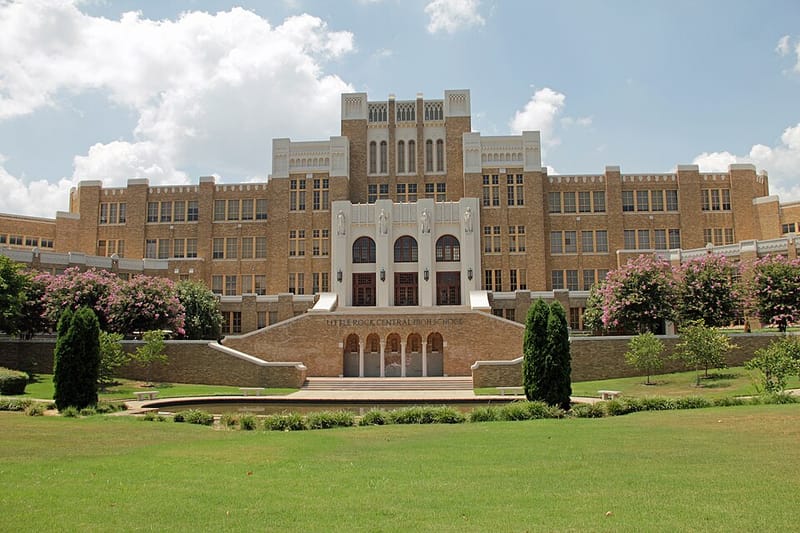
Then he attacked segregation itself. In 1949 he met Black parents in Clarendon County, South Carolina, whose case, Briggs v. Elliott, became part of Brown. Using social science evidence that segregation harmed Black children, he argued in 1952 and 1953 that separate could never be equal; on May 17, 1954, the Court agreed unanimously. “Equal,” he once said, “means getting the same thing, at the same time and in the same place.” In 1957 his team won the injunction that opened Little Rock’s Central High School to nine Black students.
President Kennedy appointed him to the U.S. Court of Appeals for the Second Circuit in 1961; none of his opinions there was reversed by the Supreme Court. In 1965 Lyndon Johnson made him solicitor general, the government’s chief lawyer before the Court, and in 1967 nominated him to the Supreme Court itself.
Beliefs and ideas
Marshall saw the Constitution as a living document and the courts as the surest road to equality. He respected Martin Luther King Jr. as “a great speaker” and conceded that the protests “reached people’s consciousness,” but he distrusted civil disobedience: “If you want to write a book,” he recalled telling King, who often cited Thoreau, “you go to jail and write it.” On the Court he championed individual rights and civil rights and sought to limit criminal punishment; with Justice William Brennan he argued that the death penalty was unconstitutional in all circumstances.
Controversies, limits, and criticism
Marshall’s preference for lawsuits over street protest put him at odds with King and younger activists over tactics. As the Court shifted toward conservatism, he found himself increasingly in dissent and frustrated as his influence waned — dissenting, for example, when the Court reversed course on the death penalty in Gregg v. Georgia.
Legacy
Marshall retired in 1991 and was succeeded by Clarence Thomas. He died of heart failure in Bethesda, Maryland, on January 24, 1993. The strategy he and Houston built — case by case, until segregation itself could be challenged — laid the constitutional foundation on which the civil rights movement stood. His career ran from a segregated Baltimore schoolroom to the Supreme Court bench.
Study this entry
Check your understanding
Try answering in your own words, then open the answer.
1.What shaped Thurgood Marshall early in life?Show answerHide
Marshall was born on July 2, 1908, in Baltimore, the son of a kindergarten teacher and a railroad dining-car waiter. On his days off, his father took the boys to watch trials and then made them argue legal questions at home, challenging every point.From “Early life and context” above.
2.What were Thurgood Marshall’s major achievements?Show answerHide
One of Marshall’s first victories forced the University of Maryland’s law school — the school that had rejected him — to admit a Black student. He joined the NAACP’s national staff, succeeded Houston as its chief counsel in 1938, and from 1940 directed the new NAACP Legal Defense and Educational Fund.From “Major actions and achievements” above.
3.What criticism or controversy surrounds Thurgood Marshall?Show answerHide
Marshall’s preference for lawsuits over street protest put him at odds with King and younger activists over tactics.From “Controversies, limits, and criticism” above.
4.How is Thurgood Marshall remembered?Show answerHide
Marshall retired in 1991 and was succeeded by Clarence Thomas. He died of heart failure in Bethesda, Maryland, on January 24, 1993.From “Legacy” above.
Turn this entry into 9 flashcards (key facts, dates, and why it matters) and review them in Learn.
Related History
How this connects to the rest of the atlas.
People
Court cases

Sources
- 1.Marshall, Thurgood
The Martin Luther King, Jr. Research and Education Institute, Stanford University · Scholarly · cited for life and career
- 2.Little Rock School Desegregation
The Martin Luther King, Jr. Research and Education Institute, Stanford University · Scholarly · cited for Little Rock Nine, Faubus, Eisenhower
- 3.Brown v. Board of Education (1954) — Milestone Documents
National Archives · Primary source · cited for ruling, Brown II, reaction
- 4.Thurgood Marshall
Oyez (Legal Information Institute, Cornell, and Justia) · Reference · cited for family, education, early practice, NAACP career, years on the Court, death
- 5.Marshall, Thurgood
Federal Judicial Center · Institutional · cited for judicial appointments and service dates
- 6.Thurgood Marshall
National Park Service · Institutional · cited for Howard Law School, Briggs case, strategy, first Black justice
Image credits
- Thurgood-marshall-2, Robert S. Oakes, 1976. Via Wikimedia Commons · Public domain · Source
Written for American History Atlas from the sources above. See how entries are researched.
Atlas by Alexander. More on Telegram.