The Salem Witch Trials
The 1692 witch hunt in Puritan Massachusetts that sent twenty people to their deaths
February 1692 – 1693Salem Village (now Danvers), Salem Town, Andover, and nearby towns, Massachusetts
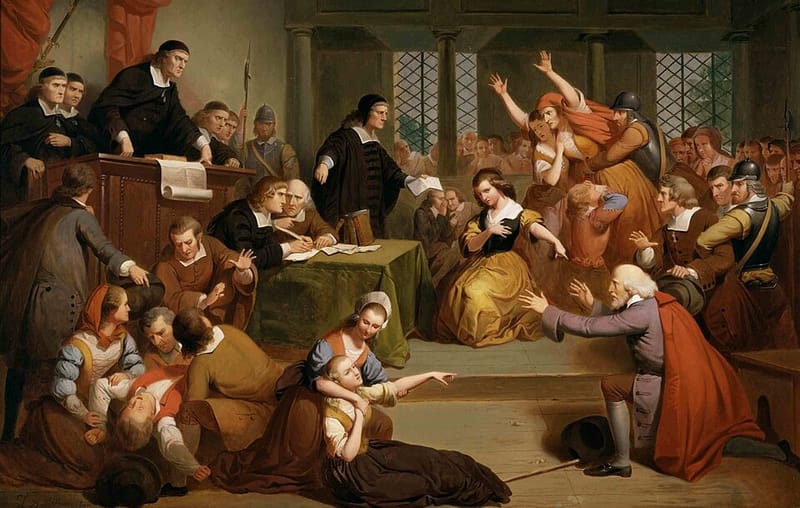
In 1692 a panic over witchcraft swept Salem Village and neighboring towns in Puritan Massachusetts. It began when two girls in the household of the village minister fell into fits and three women were arrested for bewitching them; within months hundreds of people had been accused. A special court, relying on “spectral evidence” — testimony that an accused person’s spirit had tormented the victims — sentenced people to death. Nineteen people were hanged and one man was pressed to death with stones before the governor shut the court down. The trials became America’s most famous warning against mass hysteria and false accusation.
Key facts
- Date
- February 1692 – 1693
- Location
- Salem Village (now Danvers), Salem Town, Andover, and nearby towns, Massachusetts
- First accused
- Tituba, Sarah Good, and Sarah Osborne — warrants issued February 29, 1692
- First executed
- Bridget Bishop, hanged June 10, 1692
- Death toll
- Nineteen hanged (fourteen women, five men), Giles Corey pressed to death, and five others died in prison
- The court
- A special Court of Oyer and Terminer, set up May 27 and closed October 29, 1692
- Last name cleared
- Elizabeth Johnson Jr., exonerated by the Massachusetts legislature in 2022
Why it matters
Salem showed how fear, local feuds, and unsound legal procedure could combine to destroy innocent lives. It has become the American byword for a “witch hunt” and a lasting argument for due process.
Historical background
Late-seventeenth-century Massachusetts was an anxious place. King Philip’s War of 1675–1676 had devastated New England, tensions with Native peoples endured, and the colony was in political turmoil. Salem Village (now Danvers), a rural community about five miles north of Salem Town, was divided by bitter quarrels among leading families such as the Putnams and the Nurses. Its minister was the Reverend Samuel Parris.
Causes and contributing factors
Historians point to many causes: local rivalries and family feuds, political turmoil, the enduring trauma of war, and a faulty legal process in which confessing — and accusing others — became the surest way for the accused to save their own lives. Some scholars have even suggested low-level environmental contamination. The court gave spectral evidence an unprecedented status, turning neighbors’ fears and grudges into convictions.
What happened
In early 1692 Parris’s daughter Betty and her twelve-year-old cousin Abigail Williams began to suffer strange fits, which were diagnosed as witchcraft. On February 29 warrants were issued for three women: Sarah Good, a poor and disreputable woman; Sarah Osborne; and Tituba, a Native American or African woman enslaved in the Parris household. Tituba confessed, setting a fatal pattern: the accused who confessed and named others were spared, while those who insisted on their innocence were condemned. Accusations spread to respected church members such as Martha Corey and Rebecca Nurse, and to Andover, Ipswich, and other towns.
On May 27 Governor William Phips created a special Court of Oyer and Terminer. Its first defendant, Bridget Bishop, was convicted largely on spectral evidence and hanged on June 10. When a jury found Rebecca Nurse not guilty, the judges told it to reconsider, and she was hanged on July 19. The minister George Burroughs declared his innocence on the gallows ladder and recited the Lord’s Prayer — which Increase Mather believed no witch could do perfectly — moving spectators to tears, but he was hanged anyway. Giles Corey refused to submit to a trial and was slowly crushed under heavy stones in September. In all, between June 10 and September 22 the court in Salem sent twenty people to their deaths. As doubts about spectral evidence mounted among ministers, Phips closed the court on October 29.
Immediate consequences
As the scale of the injustice sank in, Phips threw out the death sentence of twenty-two-year-old Elizabeth Johnson Jr., convicted in 1693. Some of the jailed could not leave until their prison fees were paid — Tituba remained in jail for thirteen months after Parris refused to pay hers. In 1697 Samuel Sewall, one of the judges, issued a public confession of his wrongdoing.
Long-term significance
Over the following centuries dozens of the accused were officially cleared, though some names were overlooked. The last, Elizabeth Johnson Jr., was formally exonerated in 2022 after an eighth-grade civics class in North Andover took up her case. Salem itself, where a memorial now marks an execution site, has become a center of remembrance and tourism, with reenactments of the trials. The trials remain a warning about scapegoating, the danger of convicting people on evidence that cannot be tested, and how quickly a community can turn on its own members.
Study this entry
Check your understanding
Try answering in your own words, then open the answer.
1.What led to the Salem Witch Trials?Show answerHide
Historians point to many causes: local rivalries and family feuds, political turmoil, the enduring trauma of war, and a faulty legal process in which confessing — and accusing others — became the surest way for the accused to save their own lives. Some scholars have even suggested low-level environmental contamination.From “Causes and contributing factors” above.
2.What happened?Show answerHide
In early 1692 Parris’s daughter Betty and her twelve-year-old cousin Abigail Williams began to suffer strange fits, which were diagnosed as witchcraft.From “What happened” above.
3.What were the immediate consequences?Show answerHide
As the scale of the injustice sank in, Phips threw out the death sentence of twenty-two-year-old Elizabeth Johnson Jr., convicted in 1693. Some of the jailed could not leave until their prison fees were paid — Tituba remained in jail for thirteen months after Parris refused to pay hers.From “Immediate consequences” above.
4.Why does it still matter?Show answerHide
Over the following centuries dozens of the accused were officially cleared, though some names were overlooked. The last, Elizabeth Johnson Jr., was formally exonerated in 2022 after an eighth-grade civics class in North Andover took up her case.From “Long-term significance” above.
Turn this entry into 10 flashcards (key facts, dates, and why it matters) and review them in Learn.
Related History
How this connects to the rest of the atlas.

Sources
- 1.Important Persons in the Salem Court Records
Salem Witch Trials Documentary Archive, University of Virginia (ed. Benjamin C. Ray) · Scholarly · cited for Tituba, Bridget Bishop, Rebecca Nurse, Giles Corey, Burroughs, Phips’s court, Sewall’s apology
- 2.3. British North America
The American Yawp (Stanford University Press) · Scholarly · cited for context, death toll, causes, Tituba
- 3.Upcoming Public Lecture to Examine Salem Witch Trials Street-by-Street
National Park Service, Salem Maritime National Historical Park · Institutional · cited for twenty executed June 10–September 22, 1692; Salem Village and Salem Town
- 4.After 329 years, a woman accused of being a witch in Salem has been exonerated
NPR / Associated Press (via KUNC) · Reference · cited for 2022 exoneration of Elizabeth Johnson Jr.; toll
Image credits
- Trial of George Jacobs, August 5, 1692, T. H. Matteson, 1855. Via Wikimedia Commons · Public domain · Source
Written for American History Atlas from the sources above. See how entries are researched.
Atlas by Alexander. More on Telegram.