MovementIndustrialization and the Gilded Age
Populism and the People’s Party
The farmers’ revolt of the 1890s
1890–1896
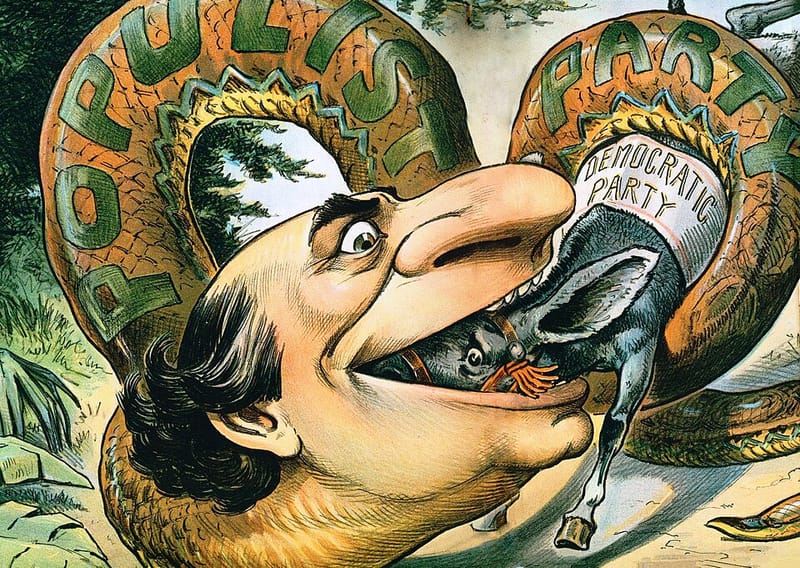
Populism was a mass political movement of farmers in the South and West who believed that railroads, banks, and the two major parties served “the moneyed power” at the expense of ordinary producers. Organized first through the Farmers’ Alliance, they formed the People’s Party, which won congressional seats in 1890 and issued the sweeping Omaha Platform in 1892. In 1896 the Populists endorsed the Democrat William Jennings Bryan and soon faded — but many of their proposals later became law.
Key facts
- Date
- 1890–1896
- Dating note
- The Populists won their first victories in the 1890 midterm elections, adopted the Omaha Platform in 1892, and merged with the Democrats behind William Jennings Bryan in 1896.
- First breakthrough
- 1890 midterms: nine congressional seats and state and local victories
- Omaha Platform
- Adopted July 4, 1892, at the party’s first national convention
- Key demands
- Unlimited coinage of silver, a graduated income tax, government ownership of railroads and telegraphs, direct election of senators
- 1896
- Endorsed Democrat William Jennings Bryan
Why it matters
The Populist revolt was the largest third-party challenge of the Gilded Age, and it put the regulation of corporations and the expansion of democracy on the national agenda.
Goals
Populists believed national policies favored industry, banks, and the Northeast over farmers, who faced falling crop prices, debt, and high railroad rates. They sought to expand the money supply — especially through the free coinage of silver — to ease debts; to regulate or nationalize railroads and telegraphs; to institute a graduated income tax; and to make government more directly answerable to voters.
Strategies
Farmers organized through cooperative Farmers’ Alliances and then turned to independent politics. Meeting in Omaha on the 116th anniversary of the Declaration of Independence, July 4, 1892, the People’s Party declared that the nation had been “brought to the verge of moral, political, and material ruin” and that both major parties had permitted “grievous wrongs” against “a plundered people.”
Opposition
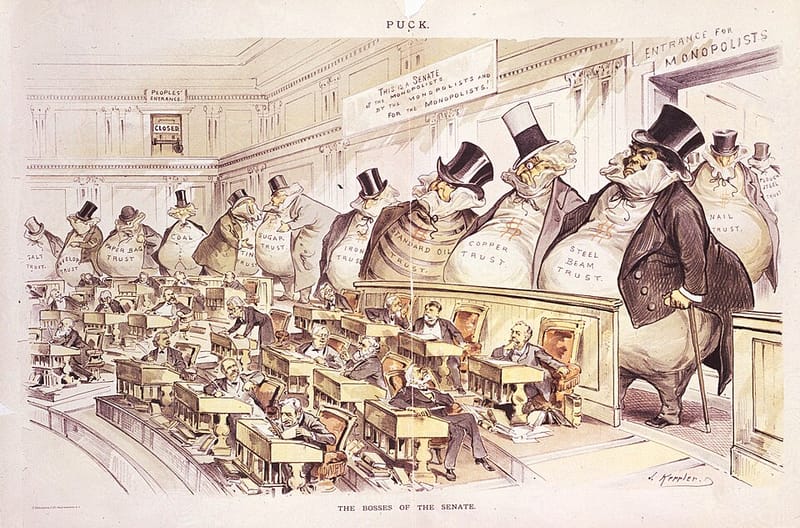
Republicans were attacked by the Populists for serving the “moneyed” power of the Northeast, and Southern Democrats were put on notice as small farmers broke away. Both major parties, business interests, and much of the press in turn portrayed the Populists as dangerous radicals.
Achievements
Though their presidential bids failed, the Populists set the stage for William Jennings Bryan’s Democratic campaign of 1896. Several of their demands were later written into the Constitution: a federal income tax (Sixteenth Amendment, 1913) and the direct election of senators (Seventeenth Amendment, 1913).
Unresolved questions
Historians debate Populism’s character: a democratic movement of producers against concentrated power, or one that also carried nativist and racial prejudices. The word “populism” is still used to describe movements that claim to speak for ordinary people against elites.
Study this entry
Check your understanding
Try answering in your own words, then open the answer.
1.What did the movement want?Show answerHide
Populists believed national policies favored industry, banks, and the Northeast over farmers, who faced falling crop prices, debt, and high railroad rates.From “Goals” above.
2.How did it pursue its goals?Show answerHide
Farmers organized through cooperative Farmers’ Alliances and then turned to independent politics.From “Strategies” above.
3.Who opposed it, and how?Show answerHide
Republicans were attacked by the Populists for serving the “moneyed” power of the Northeast, and Southern Democrats were put on notice as small farmers broke away. Both major parties, business interests, and much of the press in turn portrayed the Populists as dangerous radicals.From “Opposition” above.
4.What did it achieve?Show answerHide
Though their presidential bids failed, the Populists set the stage for William Jennings Bryan’s Democratic campaign of 1896. Several of their demands were later written into the Constitution: a federal income tax (Sixteenth Amendment, 1913) and the direct election of senators (Seventeenth Amendment, 1913).From “Achievements” above.
Turn this entry into 10 flashcards (key facts, dates, and why it matters) and review them in Learn.
Related History
How this connects to the rest of the atlas.
Movements
Institutions

Sources
- 1.Populist Party Platform (1892)
Teaching American History, Ashland University · Primary source · cited for 1890 gains, Omaha platform text, link to Bryan
- 2.The “Omaha Platform” of the People’s Party (1892)
The American Yawp Reader · Primary source · cited for platform
- 3.The American Yawp, “Capital and Labor”
The American Yawp (eds. Joseph Locke and Ben Wright; Stanford University Press) · Scholarly · cited for Gilded Age, labor organizing, strikes
- 4.16th Amendment — Milestone Documents
National Archives · Primary source · cited for federal income tax
- 5.17th Amendment — Milestone Documents
National Archives · Primary source · cited for direct election of senators
Image credits
- Bryan, Judge magazine, 1896, 1896. Via Wikimedia Commons · Public domain · Source
Written for American History Atlas from the sources above. See how entries are researched.
Atlas by Alexander. More on Telegram.