EventCivil War and Reconstruction
The Assassination of Abraham Lincoln
Ford’s Theatre, April 14, 1865
April 14, 1865Ford’s Theatre, Washington, D.C.
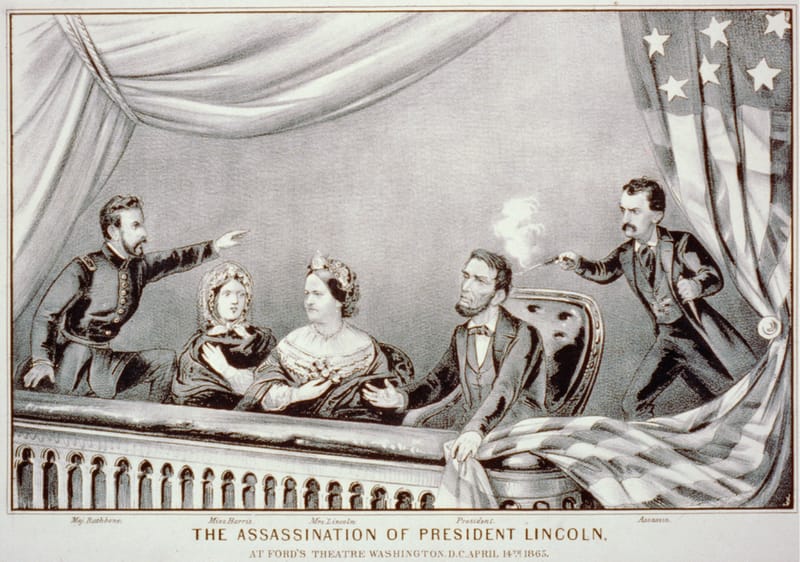
On the evening of April 14, 1865 — five days after Lee’s surrender at Appomattox — President Abraham Lincoln was shot in the head by the actor John Wilkes Booth while watching a play at Ford’s Theatre in Washington. He died the next morning, the first American president to be assassinated. Booth, a Confederate sympathizer, had plotted with others to kill several leaders of the government. Lincoln’s death turned the celebration of victory into national mourning and placed Andrew Johnson in charge of Reconstruction.
Key facts
- Date
- April 14, 1865
- Location
- Ford’s Theatre, Washington, D.C.
- Date
- April 14, 1865; Lincoln died the morning of April 15
- Assassin
- John Wilkes Booth, actor and Confederate sympathizer
- Other targets
- Secretary of State William H. Seward, Vice President Andrew Johnson, General Ulysses S. Grant
- Aftermath
- Booth was found and killed ten days later; four co-conspirators were hanged
Why it matters
The first assassination of an American president cut short Lincoln’s leadership at the moment of victory and profoundly shaped how the nation approached Reconstruction.
Historical background
On April 3, 1865, Lincoln walked through Richmond, the fallen Confederate capital, cheered by crowds of African Americans. On April 9 Lee surrendered at Appomattox. On April 11, Lincoln publicly endorsed voting rights for some Black men.
Causes and contributing factors
John Wilkes Booth, a member of a well-known acting family and an ardent Confederate sympathizer, had spent much of the war plotting to kidnap Lincoln as a bargaining chip for the Confederacy. When he heard Lincoln endorse Black suffrage on April 11, he conspired with accomplices to kill Lincoln, Secretary of State William Seward, Vice President Andrew Johnson, and General Grant.
What happened
On April 14, Lincoln and his wife, Mary Todd Lincoln, attended a performance of the comedy Our American Cousin at Ford’s Theatre. Booth entered the presidential box and shot Lincoln point-blank in the back of the head, then leapt to the stage shouting “Sic semper tyrannis!” and escaped. Lincoln died early the next morning.
Immediate consequences
After a frantic search, Booth was found hiding in a barn in rural Virginia ten days later and was killed. Four of his co-conspirators were convicted and hanged. After seven days of official mourning, Lincoln’s funeral train carried his body 1,700 miles to Springfield, Illinois, as crowds gathered in towns and cities along the way.
Long-term significance
Lincoln’s death made him a national martyr and removed the leader best positioned to guide Reconstruction. His successor, Andrew Johnson — whom Booth’s plot had also targeted — pursued a lenient policy toward the defeated South that sparked a bitter conflict with Congress. Ford’s Theatre is preserved today as part of Ford’s Theatre National Historic Site.
Key peopleAbraham Lincoln
Study this entry
Check your understanding
Try answering in your own words, then open the answer.
1.What led to the Assassination of Abraham Lincoln?Show answerHide
John Wilkes Booth, a member of a well-known acting family and an ardent Confederate sympathizer, had spent much of the war plotting to kidnap Lincoln as a bargaining chip for the Confederacy.From “Causes and contributing factors” above.
2.What happened?Show answerHide
On April 14, Lincoln and his wife, Mary Todd Lincoln, attended a performance of the comedy Our American Cousin at Ford’s Theatre. Booth entered the presidential box and shot Lincoln point-blank in the back of the head, then leapt to the stage shouting “Sic semper tyrannis!” and escaped.From “What happened” above.
3.What were the immediate consequences?Show answerHide
After a frantic search, Booth was found hiding in a barn in rural Virginia ten days later and was killed. Four of his co-conspirators were convicted and hanged.From “Immediate consequences” above.
4.Why does it still matter?Show answerHide
Lincoln’s death made him a national martyr and removed the leader best positioned to guide Reconstruction. His successor, Andrew Johnson — whom Booth’s plot had also targeted — pursued a lenient policy toward the defeated South that sparked a bitter conflict with Congress.From “Long-term significance” above.
Turn this entry into 10 flashcards (key facts, dates, and why it matters) and review them in Learn.
Related History
How this connects to the rest of the atlas.
Events

Sources
- 1.Abraham Lincoln: Death of the President
Miller Center, University of Virginia · Scholarly · cited for Richmond, Appomattox, assassination, Booth, funeral train
- 2.Ford’s Theatre — History & Culture
National Park Service, Ford’s Theatre National Historic Site · Institutional · cited for the theater site
Image credits
- The Assassination of President Lincoln - Currier and Ives, Currier & Ives, 1865., circa 1865. Via Wikimedia Commons · Public domain · Source
Written for American History Atlas from the sources above. See how entries are researched.
Atlas by Alexander. More on Telegram.