PersonCivil Rights and Social Transformation
Richard Nixon
Thirty-seventh president: opened relations with China, then became the only president to resign
1913–1994
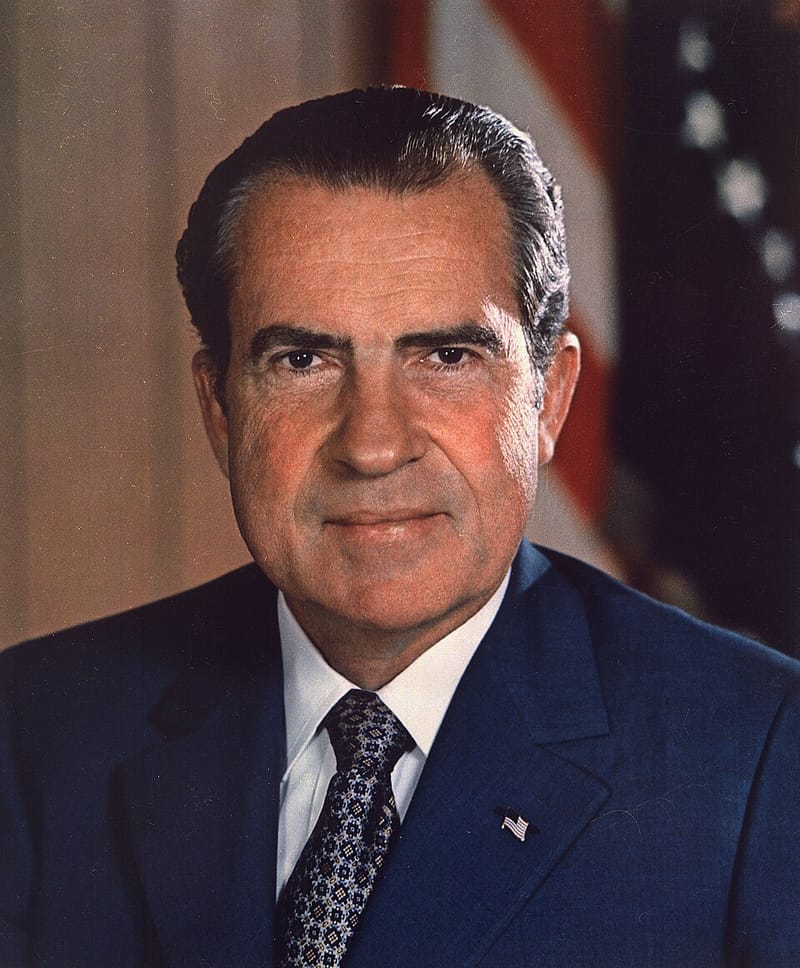
Richard Nixon rose from a small California town to the vice presidency in six years, lost the presidency to John F. Kennedy in 1960, and won it in 1968. A lifelong anticommunist, he stunned the world by visiting Communist China in 1972, signed landmark nuclear arms limitation treaties with the Soviet Union, and ended the American ground war in Vietnam; at home he created the Environmental Protection Agency. Reelected in a 49-state landslide, he was brought down by the Watergate scandal and in 1974 became the first and only president to resign.
Key facts
- Born
- January 9, 1913, Yorba Linda, California
- Died
- April 22, 1994
- Roles
- U.S. Representative from California (1947–1950); U.S. Senator from California (1950–1953); Vice president under Eisenhower (1953–1961); Thirty-seventh president (1969–1974)
- Presidency
- January 20, 1969 – August 9, 1974; Republican
- Opening to China
- Visited Beijing in February 1972 — “Only Nixon could go to China”
- Arms control
- First president to visit Moscow; signed the SALT and Anti-Ballistic Missile treaties in 1972
- 1972 landslide
- Won 49 of 50 states, all but Massachusetts
- At home
- Signed laws creating OSHA (1970) and the Endangered Species Act (1973); proposed the EPA
- Resignation
- August 9, 1974, facing impeachment; pardoned by Gerald Ford a month later
Why it matters
Nixon's diplomacy with China and the Soviet Union reshaped the Cold War and set the stage for its end, and his presidency marked the shift from liberal Democratic to conservative Republican dominance. Watergate made him a lasting symbol of the abuse of presidential power and deepened Americans' distrust of their leaders.
Early life and context
Nixon was born on January 9, 1913, in Yorba Linda, California, and grew up in another small town, East Whittier. His father, Frank, was argumentative, his mother, Hannah, sweet-tempered. As a young man he lost two brothers, Arthur after a short illness and Harold after a long one. He won debates, school elections, and leading roles in plays, and earned excellent grades at Whittier College and Duke University’s law school — yet the FBI and several prestigious law firms turned him down. Back in Whittier he joined a law firm and a community theater, where he fell for a fellow cast member, Thelma “Pat” Ryan; they married in 1940. During World War II he served in the Navy.
In 1946 Southern California Republicans chose him to run for Congress. He beat a five-term New Deal Democrat, Jerry Voorhis, by falsely linking him to a communist-infiltrated labor committee — the start of what the historian Garry Wills called Nixon’s “denigrative method.” On the House Un-American Activities Committee he became a national star by exposing Alger Hiss, a former State Department official who was shown to have passed information to the Soviets. In 1950 he won a Senate seat with a campaign whose “pink sheet” likened his opponent Helen Gahagan Douglas’s voting record to that of a Communist Party–line congressman, earning the lasting nickname “Tricky Dick.”
Major actions and achievements
In 1952 Dwight Eisenhower chose Nixon as his running mate. When a newspaper charged that a secret fund kept him in style, he defended himself on national television, promising his little daughter Tricia that he would never return one campaign gift — a cocker spaniel puppy named Checkers. The public response to the “Checkers Speech” was overwhelmingly positive. As vice president he traveled widely: a mob stoned his motorcade in Caracas, Venezuela, and in 1959 he sparred with Soviet leader Nikita Khrushchev in the Soviet Union in front of a model American kitchen, the famous “kitchen debate.” After losing to Kennedy in 1960 and in the California governor’s race in 1962, he rebuilt his career by campaigning loyally for Republicans and won the presidency in 1968 by less than one percentage point, with 43 percent of the vote in a three-way race.
Foreign policy was his passion. With his national security adviser, Henry Kissinger, he played the Communist rivals against each other. After China invited an American table tennis team in 1971, Kissinger held secret talks, and in February 1972 Nixon made a widely televised visit to Beijing. Later in 1972 he became the first president to visit Moscow, where he and Leonid Brezhnev signed the Strategic Arms Limitation Treaty and the Anti-Ballistic Missile Treaty. He withdrew American troops from Vietnam gradually under “Vietnamization,” and the Paris Peace Accords of January 1973 ended the participation of U.S. ground forces. At home, his administration imposed more new regulation than any since the New Deal: he signed the law creating the Occupational Safety and Health Administration, proposed the Environmental Protection Agency, and signed the Clean Air Act amendments of 1970, the Endangered Species Act, and the Safe Drinking Water Act. In 1971 he stunned the country with a wage-and-price freeze and closed the “gold window” that let other nations trade dollars for American gold.
Beliefs and ideas
Nixon was by conviction a conservative and a militant anticommunist, but a supremely flexible tactician — “only as conservative as he could be and only as liberal as he had to be,” in the Miller Center’s phrase. He imposed wage and price controls he believed would not work, for election-year effect, and he took credit for the EPA while privately noting that a Democratic Congress would otherwise have forced stronger laws on him. His steady aim was to move the country to the right and to build a new conservative governing majority, and he did. He believed in concentrating foreign policy power in the White House, and his “Nixon Doctrine” called for aiding allies while expecting them to provide the soldiers for their own defense.
Controversies, limits, and criticism
Nixon secretly bombed Cambodia in 1969 and in 1970 sent troops into Cambodia, setting off the largest antiwar protests in American history; National Guardsmen killed four students at Kent State University, and police killed two at Jackson State. His own White House tapes later showed that he expected South Vietnam to collapse after American troops left and prolonged the war to postpone that collapse until after his 1972 reelection. During the 1968 campaign his aides had privately urged South Vietnam to stay away from peace talks. After the Pentagon Papers leaked in 1971, he created a secret White House unit, the “Plumbers,” which burglarized the office of the leaker Daniel Ellsberg’s psychiatrist; some of the same men were arrested breaking into the Democratic National Committee’s offices at the Watergate complex on June 17, 1972. Nixon’s effort to cover up these crimes, proven by his own tapes, led the House Judiciary Committee to approve articles of impeachment.
Legacy
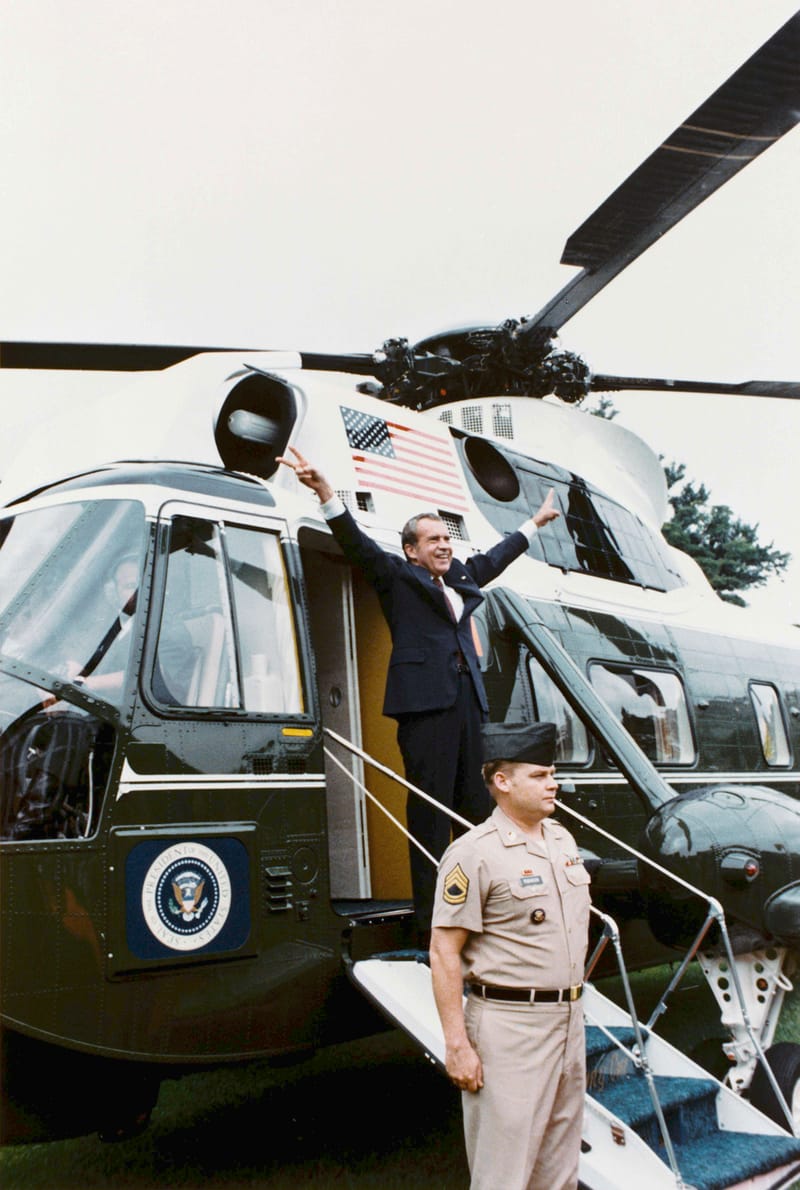
Nixon resigned on August 9, 1974; his successor, Gerald Ford, declared that “our long national nightmare is over” and a month later granted him a full pardon. In retirement Nixon slowly rebuilt his reputation as a foreign policy elder: he sold his memoirs, gave a televised interview to David Frost in 1977, wrote books, and was quietly consulted by later presidents. He died on April 22, 1994, and every living president attended his funeral. Historians see his presidency as pivotal — the moment American politics turned from a liberal to a conservative era, and the time when arms control and the opening to China laid groundwork for the end of the Cold War. But his secret tapes, in the Miller Center’s words, make his presidency “an object lesson in the difference between image and reality.”
Study this entry
Check your understanding
Try answering in your own words, then open the answer.
1.What shaped Richard Nixon early in life?Show answerHide
Nixon was born on January 9, 1913, in Yorba Linda, California, and grew up in another small town, East Whittier. His father, Frank, was argumentative, his mother, Hannah, sweet-tempered.From “Early life and context” above.
2.What were Richard Nixon’s major achievements?Show answerHide
In 1952 Dwight Eisenhower chose Nixon as his running mate. When a newspaper charged that a secret fund kept him in style, he defended himself on national television, promising his little daughter Tricia that he would never return one campaign gift — a cocker spaniel puppy named Checkers.From “Major actions and achievements” above.
3.What criticism or controversy surrounds Richard Nixon?Show answerHide
Nixon secretly bombed Cambodia in 1969 and in 1970 sent troops into Cambodia, setting off the largest antiwar protests in American history; National Guardsmen killed four students at Kent State University, and police killed two at Jackson State.From “Controversies, limits, and criticism” above.
4.How is Richard Nixon remembered?Show answerHide
Nixon resigned on August 9, 1974; his successor, Gerald Ford, declared that “our long national nightmare is over” and a month later granted him a full pardon.From “Legacy” above.
Turn this entry into 12 flashcards (key facts, dates, and why it matters) and review them in Learn.
Related History
How this connects to the rest of the atlas.
Events
Wars
People
Movements

Sources
- 1.Richard Nixon (overview and fast facts)
Miller Center, University of Virginia · Scholarly · cited for dates, family, offices
- 2.Richard Nixon: Life in Brief
Miller Center, University of Virginia (Ken Hughes) · Scholarly · cited for career overview, resignation
- 3.Richard Nixon: Life Before the Presidency
Miller Center, University of Virginia (Ken Hughes) · Scholarly · cited for childhood, early campaigns, Hiss case, Checkers Speech, kitchen debate
- 4.Richard Nixon: Campaigns and Elections
Miller Center, University of Virginia (Ken Hughes) · Scholarly · cited for 1968 and 1972 elections
- 5.Richard Nixon: Domestic Affairs
Miller Center, University of Virginia (Ken Hughes) · Scholarly · cited for economy, regulation, environment, Watergate
- 6.Richard Nixon: Foreign Affairs
Miller Center, University of Virginia (Ken Hughes) · Scholarly · cited for China, détente, Vietnam, Cambodia
- 7.Richard Nixon: Life After the Presidency
Miller Center, University of Virginia (Ken Hughes) · Scholarly · cited for pardon, rehabilitation, death
- 8.Richard Nixon: Impact and Legacy
Miller Center, University of Virginia (Ken Hughes) · Scholarly · cited for assessment, tapes
Image credits
- President Richard Nixon, Department of Defense. Department of the Army. Office of the Deputy Chief of Staff for Operations. U.S. Army Audiovisual Center. (ca. 1974 - 05/15/1984), 1 June 1972, per [1] [2] [3]. Via Wikimedia Commons · Public domain · Source
Written for American History Atlas from the sources above. See how entries are researched.
Atlas by Alexander. More on Telegram.