PersonIndustrialization and the Gilded Age
Andrew Carnegie
Steel magnate and philanthropist of the Gilded Age
1835–1919
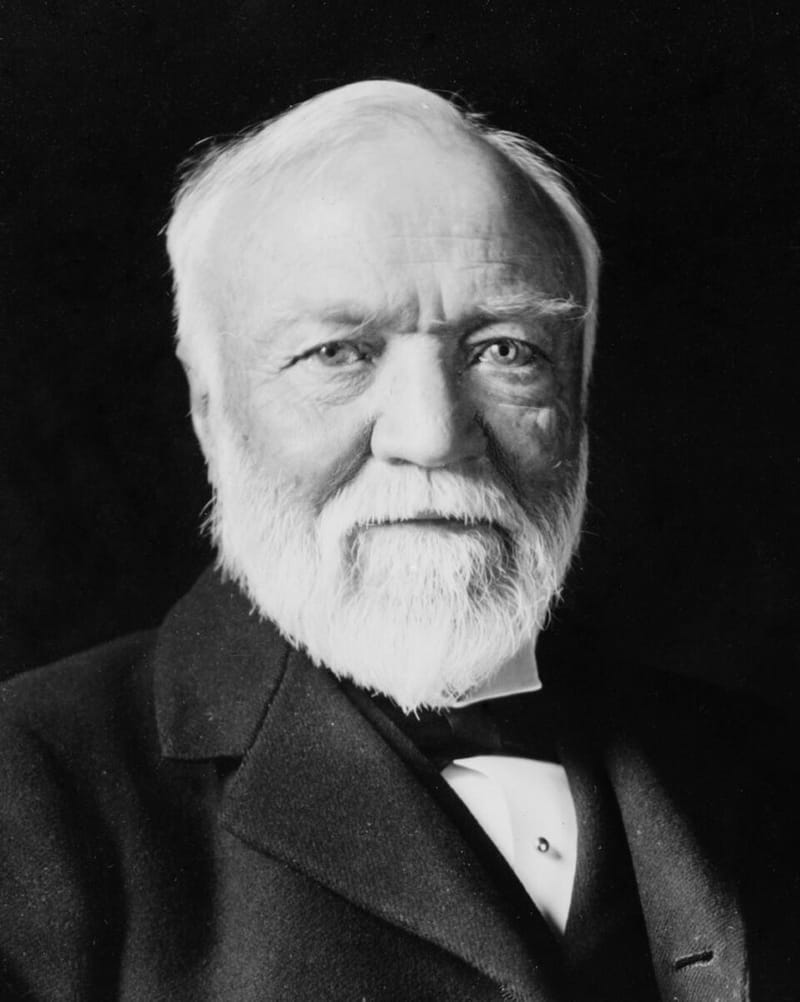
Andrew Carnegie arrived in Pennsylvania as a poor thirteen-year-old Scottish immigrant and built the largest and most profitable steel company in the world. In 1901 he sold it to J. P. Morgan, who used it to create U.S. Steel, and Carnegie spent the rest of his life giving his fortune away — funding thousands of public libraries and institutions. His mills were also the scene of the violent 1892 Homestead strike, and he remains a symbol of both the opportunity and the inequality of the Gilded Age.
Key facts
- Born
- 1835, Dunfermline, Scotland
- Died
- 1919
- Roles
- Telegrapher and railroad manager; Founder of Carnegie Steel; Philanthropist; author of “The Gospel of Wealth”
- Immigrated
- 1848, at age 13, from Dunfermline, Scotland, to Allegheny, Pennsylvania
- First job
- Bobbin boy in a cotton mill, $1.20 a week
- Sold Carnegie Steel
- 1901, to J. P. Morgan, forming U.S. Steel
- Philanthropy
- About half of America’s public libraries had been built with his money by his death in 1919
Why it matters
Carnegie’s rise from immigrant mill boy to steel king made him the era’s emblem of the self-made man, while Homestead and his philanthropy raised enduring questions about wealth, power, and responsibility.
Early life and context
Carnegie was born in 1835 in a one-room house in Dunfermline, Scotland, the son of a handloom weaver. When machines took over weaving in the 1840s the family was impoverished, and in 1848 his strong-willed mother led them to Allegheny, Pennsylvania. At thirteen, his schooling over, Andrew went to work as a bobbin boy in a cotton mill for $1.20 a week, twelve hours a day, six days a week. The next year he became a $2-a-week telegraph messenger, learned to read messages by ear, and was promoted to operator. A local man, Colonel James Anderson, let working boys borrow books from his library; Carnegie read all he could and resolved that if he ever became rich he would give other working boys the same chance. Thomas A. Scott of the Pennsylvania Railroad hired him as his personal telegrapher, and by 1859, at twenty-four, Carnegie ran the railroad’s Western Division.
Major actions and achievements
Mentored by Scott, who helped him invest — often in insider deals — Carnegie was rich by the end of the Civil War. He bet on steel. Henry Bessemer’s process, invented in 1857, made steel in large quantities at a fraction of the old cost, and Carnegie left the railroad to build mills supplying rails to the booming railroads; he shrewdly named his first steel mill after the Pennsylvania Railroad’s president, J. Edgar Thomson, and the railroad became his best customer. His method was relentless: save profits in good times, expand during depressions when construction was cheap and rivals had to sell, and keep cutting costs through new technology. He bought up sources of raw materials and shipping (vertical integration) and absorbed competitors (horizontal integration). American steel output rose from 13,000 tons in 1860 to more than 11 million in 1900 — more than England and Germany combined — and by the 1890s Carnegie Steel was the largest and most profitable steel company in the world.
In 1901, after a round of golf, Carnegie agreed to sell to J. P. Morgan for $492 million; Morgan merged Carnegie Steel with other firms into U.S. Steel, the world’s largest corporation. “Congratulations on becoming the richest man in the world,” Morgan told him. Carnegie spent his last two decades giving away about 90 percent of his fortune: he built more than 2,500 libraries in the United States, Canada, Britain, and elsewhere, founded Carnegie Hall, the Carnegie Institute in Pittsburgh, and the technical schools that became part of Carnegie Mellon University, and in 1911 created Carnegie Corporation of New York, endowing it with $125 million by 1912 — the largest philanthropic trust ever established up to that time.
Beliefs and ideas
In his 1889 essay “The Gospel of Wealth,” Carnegie argued that great fortunes were a public trust: the rich had a moral duty to use their surplus wealth during their lifetimes “to do real and permanent good in this world,” rather than leave it to their heirs. “The man who dies rich,” he wrote, “dies disgraced.”
Controversies, limits, and criticism
In 1892, at Carnegie’s steel mill in Homestead, Pennsylvania, the Amalgamated Association of Iron and Steel Workers struck after repeated wage cuts and occupied the mill. The plant’s operator, Henry Clay Frick, called in hundreds of Pinkerton detectives; after a pitched battle the Pinkertons surrendered, but the governor sent the state militia, broke the strike, and reopened the mill, and the union was essentially destroyed. Homestead became a symbol of the gap between Carnegie’s professed sense of social responsibility and his company’s treatment of workers. His philanthropy has also been criticized as a way of legitimizing fortunes built on low-paid labor.
Legacy
Carnegie died in 1919, by which time about half the public libraries in the United States had been built with his money. His foundation — renamed the Andrew Carnegie Foundation in 2026 — has funded work from the discovery of insulin to the creation of public broadcasting and Sesame Street. Historians still debate whether the titans of the Gilded Age were “robber barons” or creative industrialists; Carnegie, the bobbin boy who became the richest man in the world and then gave it away, embodies both sides of the question.
Study this entry
Check your understanding
Try answering in your own words, then open the answer.
1.What shaped Andrew Carnegie early in life?Show answerHide
Carnegie was born in 1835 in a one-room house in Dunfermline, Scotland, the son of a handloom weaver. When machines took over weaving in the 1840s the family was impoverished, and in 1848 his strong-willed mother led them to Allegheny, Pennsylvania.From “Early life and context” above.
2.What were Andrew Carnegie’s major achievements?Show answerHide
Mentored by Scott, who helped him invest — often in insider deals — Carnegie was rich by the end of the Civil War. He bet on steel.From “Major actions and achievements” above.
3.What criticism or controversy surrounds Andrew Carnegie?Show answerHide
In 1892, at Carnegie’s steel mill in Homestead, Pennsylvania, the Amalgamated Association of Iron and Steel Workers struck after repeated wage cuts and occupied the mill.From “Controversies, limits, and criticism” above.
4.How is Andrew Carnegie remembered?Show answerHide
Carnegie died in 1919, by which time about half the public libraries in the United States had been built with his money. His foundation — renamed the Andrew Carnegie Foundation in 2026 — has funded work from the discovery of insulin to the creation of public broadcasting and Sesame Street.From “Legacy” above.
Turn this entry into 10 flashcards (key facts, dates, and why it matters) and review them in Learn.
Related History
How this connects to the rest of the atlas.
Events
People
Movements

Sources
- 1.Andrew Carnegie and the Creation of U.S. Steel (John Steele Gordon)
Bill of Rights Institute · Scholarly · cited for early life, career, U.S. Steel, libraries
- 2.Our History
Andrew Carnegie Foundation (Carnegie Corporation of New York) · Institutional · cited for Gospel of Wealth, philanthropy, libraries
- 3.The American Yawp, “Capital and Labor”
The American Yawp (eds. Joseph Locke and Ben Wright; Stanford University Press) · Scholarly · cited for Gilded Age, labor organizing, strikes
Image credits
- Andrew Carnegie, three-quarter length portrait, seated, facing slightly left, 1913-crop, Theodore C. Marceau, Copyright 1913. Via Wikimedia Commons · Public domain · Source
Written for American History Atlas from the sources above. See how entries are researched.
Atlas by Alexander. More on Telegram.