The Erie Canal
The 363-mile “artificial river” that linked the Great Lakes to New York City in 1825
1817–1825Albany to Buffalo, New York
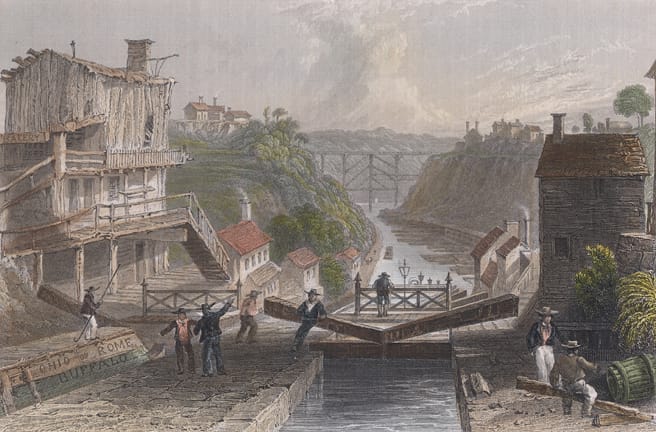
Built between 1817 and 1825, the Erie Canal ran 363 miles across upstate New York from Albany on the Hudson River to Buffalo on Lake Erie. Dug largely by hand, climbing hills through 83 locks, it was the longest artificial waterway and the greatest public works project in North America. It cut shipping costs by 90 percent, opened the interior of the continent to settlers and trade, made New York City the nation’s leading port and financial center, and launched a national canal-building boom.
Key facts
- Date
- 1817–1825
- Location
- Albany to Buffalo, New York
- Built
- 1817 (begun at Rome, New York) to 1825
- Size
- 363 miles long, 4 feet deep, 40 feet wide; 83 locks and 18 aqueducts; a 571-foot rise from Albany to Buffalo
- Cost
- $7,143,789 — repaid within ten years
- Speed and savings
- Albany to Buffalo in five days instead of two weeks by stagecoach; shipping costs cut by 90 percent
- Champion
- DeWitt Clinton, New York’s leading canal advocate
- Today
- Still in use; part of a National Historic Landmark and the Erie Canalway National Heritage Corridor (2000)
Why it matters
The Erie Canal was the centerpiece of the transportation revolution that tied the young nation together. By connecting the Midwest to the Atlantic, it made New York the “Empire State,” linked Great Lakes farms with eastern cities and factories, and showed what public investment and engineering could achieve.
Historical background
In the early 1800s hauling goods overland by ox-drawn wagon was slow and expensive. Improved roads and steamboats were beginning a transportation revolution, and states and localities began connecting rivers and streams with canals. In New York, DeWitt Clinton — a former state legislator, U.S. senator, and mayor of New York City — became the canal’s most persistent and effective champion.
Causes and contributing factors
Clinton served on the commission that made the first surveys for a canal across the state and then led the political effort that made it a reality. New York State built the canal, and it would repay its cost of more than $7 million within about ten years.
What happened
Construction began at Rome, New York, in 1817. Few Americans had any experience building canals, so the project became the nation’s first practical school of civil engineering. Laborers — mostly American-born, some Irish immigrants — worked for eight years through heat, mud, and freezing cold, earning 80 cents to a dollar a day, clearing forests and digging mile after mile largely with hand tools and animal power. They invented stump-pulling machines, developed a hydraulic cement that hardened underwater, and blasted rock with hand drills and black powder. At Lockport they cut a staircase of five locks through the solid rock of the Niagara Escarpment. The canal crossed rivers on aqueducts and climbed hills through 83 locks. It opened along its full length in 1825.
Immediate consequences
Packet boats carried passengers from Albany to Buffalo in five days, less than half the stagecoach time, and freight costs fell by 90 percent compared with ox-drawn wagons. Midwestern grain, lumber, and minerals flowed east to Albany and down the Hudson to New York City, while manufactured goods and settlers flowed west. The canal paid for itself in about ten years. Towns along its route — Syracuse, Rochester, Buffalo — boomed so fast that it was called the “Mother of Cities,” and their populations quadrupled between 1830 and 1850.
Long-term significance
The canal’s success set off a canal-building boom in other states and secured New York City’s place as the nation’s busiest port, largest city, and center of commerce and finance. It carried more westbound immigrants than any other canal over the Appalachians, and along its corridor ideas traveled too: abolitionism, women’s rights utopian experiments, and new religious movements flourished there. Enlarged three times, the canal system has operated continuously since 1825, longer than any other built transportation system in North America; its old towpath is now a 365-mile bike trail.
Study this entry
Check your understanding
Try answering in your own words, then open the answer.
1.What led to the Erie Canal?Show answerHide
Clinton served on the commission that made the first surveys for a canal across the state and then led the political effort that made it a reality. New York State built the canal, and it would repay its cost of more than $7 million within about ten years.From “Causes and contributing factors” above.
2.What happened?Show answerHide
Construction began at Rome, New York, in 1817. Few Americans had any experience building canals, so the project became the nation’s first practical school of civil engineering.From “What happened” above.
3.What were the immediate consequences?Show answerHide
Packet boats carried passengers from Albany to Buffalo in five days, less than half the stagecoach time, and freight costs fell by 90 percent compared with ox-drawn wagons. Midwestern grain, lumber, and minerals flowed east to Albany and down the Hudson to New York City, while manufactured goods and settlers flowed west.From “Immediate consequences” above.
4.Why does it still matter?Show answerHide
The canal’s success set off a canal-building boom in other states and secured New York City’s place as the nation’s busiest port, largest city, and center of commerce and finance.From “Long-term significance” above.
Turn this entry into 12 flashcards (key facts, dates, and why it matters) and review them in Learn.
Related History
How this connects to the rest of the atlas.
Events

Sources
- 1.History and Culture
Erie Canalway National Heritage Corridor (National Park Service partner) · Institutional · cited for construction, engineering, labor, DeWitt Clinton, effects, ideas, heritage corridor
- 2.Fast Facts
Erie Canalway National Heritage Corridor (National Park Service partner) · Institutional · cited for dates, dimensions, locks, cost, pay, travel times
- 3.Erie Canalway National Heritage Corridor
National Park Service · Institutional · cited for continuous operation since 1825, population growth, Empire State
- 4.8. The Market Revolution
The American Yawp (Stanford University Press) · Scholarly · cited for transportation revolution, canal boom, New York City’s rise
Image credits
- Lockport on the Erie Canal, After W. H. Bartlett, 1839. Via Wikimedia Commons · Public domain · Source
Written for American History Atlas from the sources above. See how entries are researched.
Atlas by Alexander. More on Telegram.