PersonCivil Rights and Social Transformation
Cesar Chavez
Labor leader and co-founder of the United Farm Workers
1927–1993
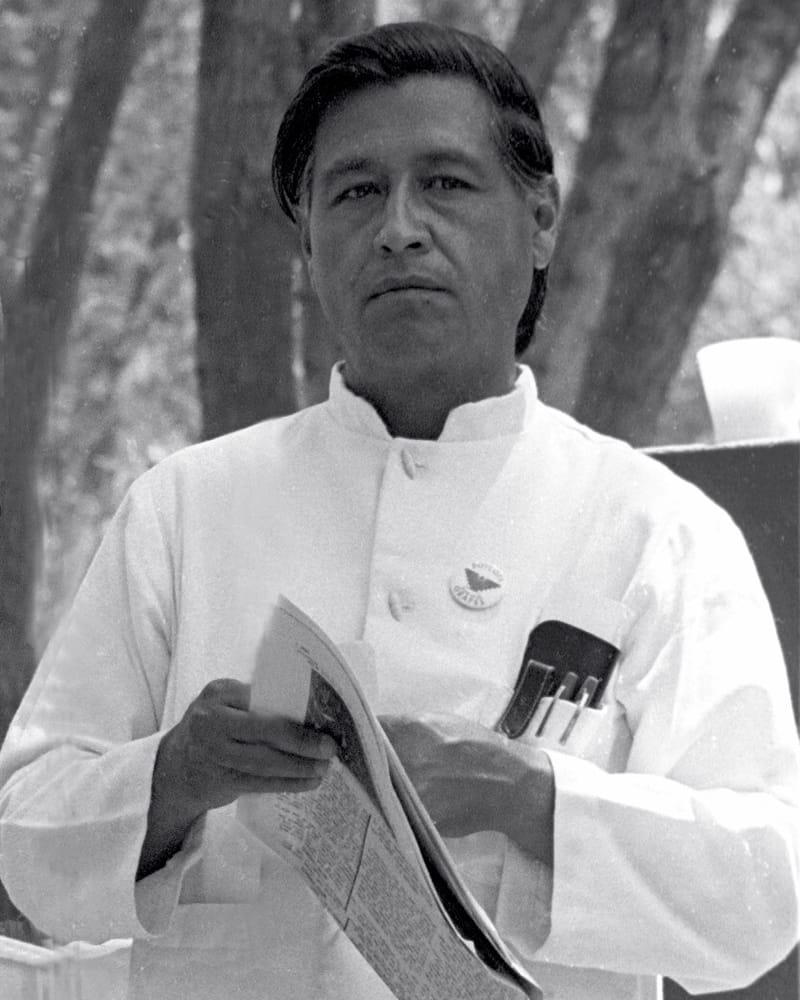
Cesar Chavez was the Mexican American labor leader who, with Dolores Huerta, built the first lasting union of farmworkers in the United States. The son of migrant laborers who had lost their Arizona farm, he founded the National Farm Workers Association in 1962, joined the great Delano grape strike of 1965, and turned it into a national boycott of table grapes. Through strikes, marches, and long public fasts — always insisting on nonviolence — he made the United Farm Workers a union and a civil rights movement at once, and became the best-known figure of the Chicano movement.
Key facts
- Born
- March 31, 1927, near Yuma, Arizona
- Died
- April 23, 1993, San Luis, Arizona
- Roles
- Organizer, Community Service Organization; Co-founder, National Farm Workers Association (1962); President, United Farm Workers
- Born
- March 31, 1927, near Yuma, Arizona
- Union
- National Farm Workers Association (1962), later the United Farm Workers
- Delano grape strike
- Began September 1965
- Fasts
- 25 days in 1968, 24 in 1972, 36 in 1988
- Died
- April 23, 1993, San Luis, Arizona
Why it matters
Chavez showed that the most marginalized workers in America could organize, and he made the farm workers’ cause a national movement for dignity and civil rights.
Early life and context
Cesar Estrada Chavez was born on March 31, 1927, near Yuma, Arizona, and named for his grandfather Cesario. He learned about injustice early: his father agreed to clear eighty acres in exchange for the deed to forty more beside their adobe home, but the bargain was broken, and after a lawyer’s scheme the family lost the land. In 1938–1939 they moved to California, settling in a San Jose barrio called Sal Si Puedes — “Get Out If You Can” — and following the harvests from Brawley to Mendota.
School was painful. Speaking only Spanish at home, Chavez was punished with a ruler across the knuckles for using it in class, saw “whites only” signs, and with his brother Richard attended thirty-seven schools. After eighth grade, in 1942, he left school to work in the fields so his mother would not have to. He served two years in the then-segregated Navy from 1946, married Helen Fabela in 1948, and raised eight children. Talks with a priest, Father Donald McDonnell, led him to read about St. Francis, Gandhi, and nonviolence; the organizer Fred Ross recruited him to the Community Service Organization (CSO), where he began by registering voters and rose to become its national director.
Major actions and achievements
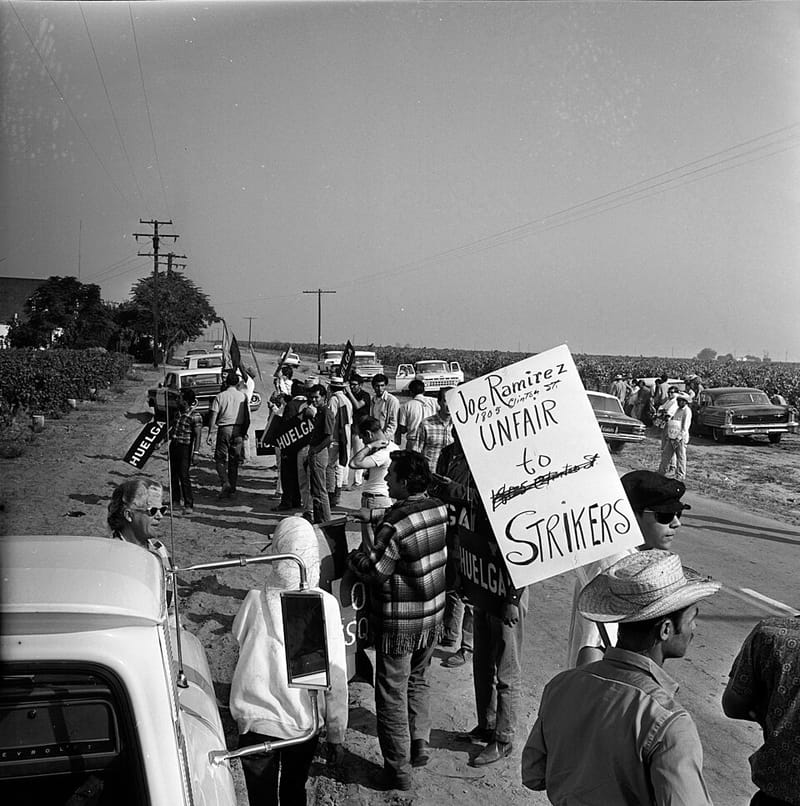
When the CSO refused to concentrate on farmworkers, Chavez quit and in 1962 founded the National Farm Workers Association in Delano, California, with Dolores Huerta; his brother Richard designed its black Aztec eagle on a red flag. For three years he traveled from town to town, meeting workers in their homes. Grape pickers then earned about 90 cents an hour, often lived in unheated shacks, and had no toilets in the fields. In September 1965, when Filipino workers led by Larry Itliong struck Delano’s grape growers, Chavez’s association — with $100 in the bank — voted to join them, to shouts of “¡Viva la huelga!”
In March 1966 Chavez led strikers on a 340-mile, 25-day march to Sacramento; on Easter morning he told 10,000 supporters at the Capitol that the grower Schenley had signed an agreement with the union. The two unions merged that summer as the United Farm Workers Organizing Committee. Volunteers fanned out to cities to organize a consumer boycott, and millions of Americans stopped buying table grapes. By 1970 the grape growers had accepted union contracts, bringing higher wages, a union hiring hall that ended contractors’ favoritism, health clinics, and a credit union; the union claimed 50,000 dues-paying members, the most ever represented in California agriculture. In 1975 California passed the Agricultural Labor Relations Act, the first U.S. law recognizing farmworkers’ right to collective bargaining.
Beliefs and ideas
Chavez’s faith in nonviolence drew on St. Francis and Gandhi. He fasted on water for 25 days in 1968, for 24 days in 1972, and for 36 days in 1988, explaining that farmworkers were “angry and worried that we cannot win without violence” and that the fasts were a call to win “through persistence, hard work, faith and willingness to sacrifice.” He believed that “the end of all education should surely be service to others,” and his office walls were lined with books on philosophy, economics, unions, and Gandhi. His union’s rallying cry was ¡Sí se puede! — “Yes, we can!”
Controversies, limits, and criticism
The union’s struggle was bitter and long. One grower sprayed strikers with agricultural poisons, and the Teamsters union offered itself to growers as a conservative alternative, colluding with growers against the farmworkers. Chavez’s final fast in 1988 protested the dangers of pesticides to workers and their children. He died while defending the union against a multimillion-dollar lawsuit brought by a lettuce grower over a 1980s boycott; the judgment was later thrown out.
Legacy
Chavez died in his sleep on April 23, 1993, in San Luis, Arizona, not far from the farm where he was born. The farmworker movement he led with Huerta and Itliong won higher wages and better working and living conditions, and grew into a national voice for the poor and disenfranchised. His birthday, March 31, is a holiday in California, Colorado, and Texas, and his home and the union headquarters at La Paz form the César E. Chávez National Monument.
Study this entry
Check your understanding
Try answering in your own words, then open the answer.
1.What shaped Cesar Chavez early in life?Show answerHide
Cesar Estrada Chavez was born on March 31, 1927, near Yuma, Arizona, and named for his grandfather Cesario. He learned about injustice early: his father agreed to clear eighty acres in exchange for the deed to forty more beside their adobe home, but the bargain was broken, and after a lawyer’s scheme the family lost the land.From “Early life and context” above.
2.What were Cesar Chavez’s major achievements?Show answerHide
When the CSO refused to concentrate on farmworkers, Chavez quit and in 1962 founded the National Farm Workers Association in Delano, California, with Dolores Huerta; his brother Richard designed its black Aztec eagle on a red flag. For three years he traveled from town to town, meeting workers in their homes.From “Major actions and achievements” above.
3.What criticism or controversy surrounds Cesar Chavez?Show answerHide
The union’s struggle was bitter and long. One grower sprayed strikers with agricultural poisons, and the Teamsters union offered itself to growers as a conservative alternative, colluding with growers against the farmworkers.From “Controversies, limits, and criticism” above.
4.How is Cesar Chavez remembered?Show answerHide
Chavez died in his sleep on April 23, 1993, in San Luis, Arizona, not far from the farm where he was born. The farmworker movement he led with Huerta and Itliong won higher wages and better working and living conditions, and grew into a national voice for the poor and disenfranchised.From “Legacy” above.
Turn this entry into 9 flashcards (key facts, dates, and why it matters) and review them in Learn.
Related History
How this connects to the rest of the atlas.
Events
Movements

Sources
- 1.The Story of Cesar Chavez
United Farm Workers · Institutional · cited for Chavez biography, fasts
- 2.UFW History
United Farm Workers · Institutional · cited for NFWA, AWOC, Delano strike, boycott, march, 1970 contracts
- 3.History & Culture — César E. Chávez National Monument
National Park Service · Institutional · cited for farm worker movement achievements, 1975 California law
- 4.César E. Chávez National Monument
National Park Service · Institutional · cited for monument
- 5.The American Yawp, “The Sixties”
The American Yawp (eds. Joseph Locke and Ben Wright; Stanford University Press) · Scholarly · cited for civil rights, Great Society, Vietnam, social movements
Image credits
Written for American History Atlas from the sources above. See how entries are researched.
Atlas by Alexander. More on Telegram.