PersonRevolution and Independence
Abigail Adams
Political partner, letter writer, and early voice for women’s rights
1744–1818
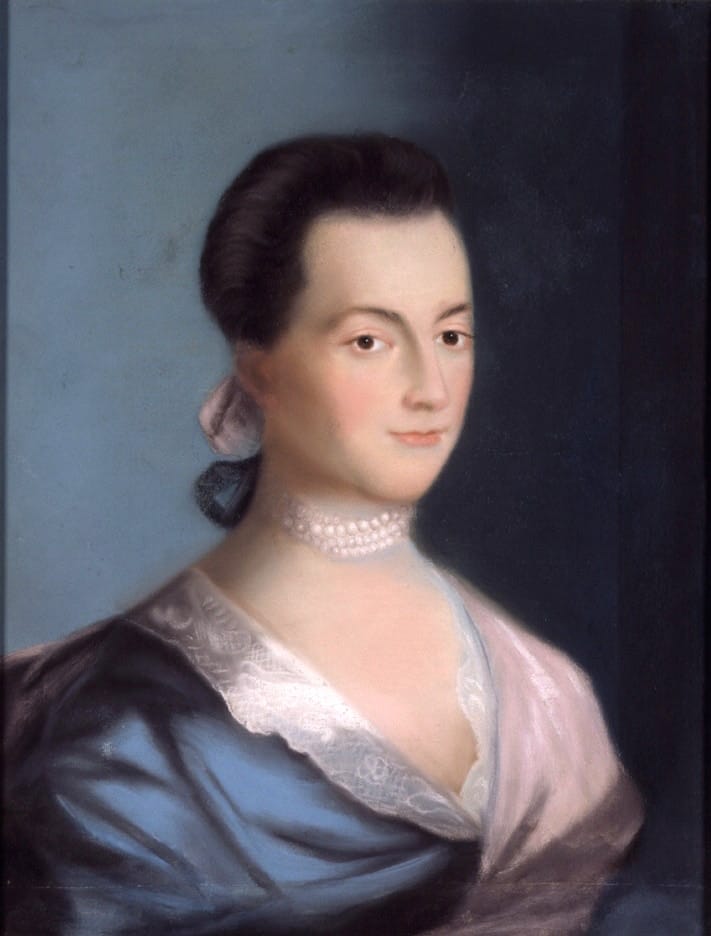
Abigail Adams was the wife of the second president, John Adams, the mother of the sixth, John Quincy Adams, and one of the sharpest political minds of the Revolutionary generation. Through a lifetime of letters she advised her husband, reported on the war, ran the family farm and finances alone for years, and asked the men writing the nation’s new laws to “remember the ladies.” An early champion of women’s education and property rights, she was also an outspoken, politically engaged First Lady.
Key facts
- Born
- November 22, 1744, Weymouth, Massachusetts
- Died
- October 28, 1818, Quincy, Massachusetts
- Roles
- Correspondent and political adviser to John Adams; Manager of the Adams farm and finances; First Lady (1797–1801); Mother of President John Quincy Adams
- Married
- John Adams, in 1764
- Children
- Including John Quincy Adams, the sixth president
- Famous letter
- March 31, 1776, to John Adams at the Continental Congress
- First Lady
- 1797–1801
- Letters published
- By her grandson Charles Francis Adams in 1848
Why it matters
Through her letters, Abigail Adams gives us one of the clearest views of the Revolution from inside a household, and her call to “Remember the Ladies” is an early marker in the long history of American women’s rights.
Early life and context
Abigail Smith was born on November 22, 1744, in Weymouth, Massachusetts, the daughter of the Reverend William Smith, a Congregational minister. New England schools then admitted only boys, and she always regretted that she had no formal education; but her father let her read freely in his large library, a cousin shared his books as he prepared for Harvard, and her brother-in-law taught her French. In 1764, at twenty, she married John Adams, a young Harvard-trained lawyer, and moved to his farm in Braintree. Their children included Abigail (“Nabby”), John Quincy, Charles, and Thomas; a daughter, Susanna, died in infancy. In Boston their circle included Samuel Adams, John Hancock, and Joseph Warren, and in 1770 the couple faced their first crisis when John risked his career to defend the British soldiers accused in the Boston Massacre.
Major actions and achievements
When John went to the Continental Congress in 1774, and then to Europe as a diplomat from 1778, Abigail stayed in Braintree and served as what the National Women’s History Museum calls a “deputy husband.” She managed the farm through wartime shortages, made investment decisions that increased the family’s wealth — trading war bonds and importing European goods for sale — and even bought land her husband opposed. She described the war around Boston in vivid letters and watched the Battle of Bunker Hill in June 1775. In her famous letter of March 31, 1776, she urged him to “Remember the Ladies” in the new code of laws: “Do not put such unlimited power into the hands of the Husbands. Remember all Men would be tyrants if they could.”
After the war she joined John in Europe, where he served as the first American minister to Great Britain, and in 1789 she moved with him to Philadelphia when he became vice president, hosting weekly dinners that mixed politics and society. When he became president in 1797 he wrote to her, “I never wanted your Advice and assistance more in my life.” Unlike the reserved Martha Washington, she was an outspoken First Lady — receiving official guests, lobbying for his policies through correspondence and at social events, and planting favorable stories in the press.
Beliefs and ideas
Adams argued that women should have a voice in the laws that governed them, warning that otherwise they would “foment a Rebellion.” Living under coverture, which gave a married woman no legal identity apart from her husband, she called for protection of women’s property and, above all, education: “If we mean to have Heroes, Statesmen and Philosophers, we should have learned women.” She believed mothers had a political role in raising virtuous citizens. She also condemned slavery, doubting that “the passion for Liberty” could be “Eaquelly Strong” in those who deprived others of theirs.
Controversies, limits, and criticism
Adams’s feminism had limits by modern standards: her vision of women’s public role centered on “Republican Motherhood” — educated mothers raising virtuous citizens. As First Lady she vigorously defended her husband’s positions, including the controversial Alien and Sedition Acts of 1798.
Legacy
After John Adams lost the election of 1800, the couple retired to Massachusetts, where Abigail surrounded herself with family, read voraciously, and corresponded with Thomas Jefferson, James and Dolley Madison, and others. She died on October 28, 1818. Her grandson Charles Francis Adams published her letters in 1848, and they offer rare insight into the social and political life of the Revolutionary era. The phrase “Remember the Ladies” has made her an icon of women’s history.
Study this entry
Check your understanding
Try answering in your own words, then open the answer.
1.What shaped Abigail Adams early in life?Show answerHide
Abigail Smith was born on November 22, 1744, in Weymouth, Massachusetts, the daughter of the Reverend William Smith, a Congregational minister.From “Early life and context” above.
2.What were Abigail Adams’s major achievements?Show answerHide
When John went to the Continental Congress in 1774, and then to Europe as a diplomat from 1778, Abigail stayed in Braintree and served as what the National Women’s History Museum calls a “deputy husband.”From “Major actions and achievements” above.
3.What criticism or controversy surrounds Abigail Adams?Show answerHide
Adams’s feminism had limits by modern standards: her vision of women’s public role centered on “Republican Motherhood” — educated mothers raising virtuous citizens. As First Lady she vigorously defended her husband’s positions, including the controversial Alien and Sedition Acts of 1798.From “Controversies, limits, and criticism” above.
4.How is Abigail Adams remembered?Show answerHide
After John Adams lost the election of 1800, the couple retired to Massachusetts, where Abigail surrounded herself with family, read voraciously, and corresponded with Thomas Jefferson, James and Dolley Madison, and others. She died on October 28, 1818.From “Legacy” above.
Turn this entry into 10 flashcards (key facts, dates, and why it matters) and review them in Learn.
Related History
How this connects to the rest of the atlas.

Sources
- 1.Abigail Smith Adams
National Women’s History Museum · Institutional · cited for biography, education, First Lady, “Remember the Ladies”
- 2.Letter from Abigail Adams to John Adams, 31 March – 5 April 1776
Massachusetts Historical Society, Adams Family Papers · Primary source · cited for quoted text
- 3.Abigail Adams
National Park Service, Adams National Historical Park · Institutional · cited for life overview
Image credits
- Abigail Adams, Benjamin Blyth, 1766. Via Wikimedia Commons · Public domain · Source
Written for American History Atlas from the sources above. See how entries are researched.
Atlas by Alexander. More on Telegram.