EventThe United States in the Twenty-First Century
September 11 Attacks
The al-Qaeda terrorist attacks of 2001
September 11, 2001New York City; Arlington, Virginia; near Shanksville, Pennsylvania
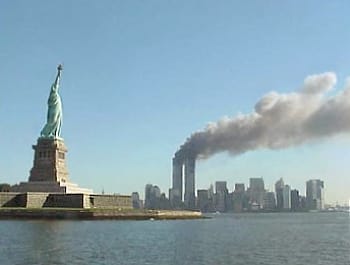
On the morning of September 11, 2001, nineteen al-Qaeda terrorists hijacked four passenger planes. Two struck the towers of the World Trade Center in New York, which collapsed; one struck the Pentagon outside Washington; and the fourth, United Flight 93, crashed in a Pennsylvania field after passengers fought back. Nearly 3,000 people were killed. The attacks led to the war in Afghanistan, a global “war on terror,” and the Iraq War, and reshaped American security and foreign policy.
Key facts
- Date
- September 11, 2001
- Location
- New York City; Arlington, Virginia; near Shanksville, Pennsylvania
- Hijackers
- Nineteen al-Qaeda operatives
- World Trade Center
- North Tower hit 8:46 a.m.; South Tower 9:03 a.m.; both collapsed
- Pentagon
- Struck at 9:37 a.m.
- Flight 93
- Crashed near Shanksville, Pennsylvania, at 10:03 a.m. after passengers revolted
- Deaths
- More than 2,600 at the WTC, 125 at the Pentagon, 256 on the planes
Why it matters
September 11 was the defining event of the early twenty-first century for the United States, transforming its foreign policy and sense of security.
Historical background
Al-Qaeda, led by the wealthy Saudi Osama bin Laden, had relocated to Afghanistan after the Taliban took power in 1996. It had been behind attacks on U.S. embassies in Africa and other targets, and by 2001 was active in more than sixty countries.
Causes and contributing factors
Bin Laden’s radical Islamist ideology cast the United States as the enemy of Muslims. The 9/11 Commission later concluded that the attacks were “a shock, but they should not have come as a surprise,” citing failures of imagination, policy, capabilities, and management across the government.
What happened
American Airlines Flight 11 crashed into the North Tower of the World Trade Center at 8:46 a.m., and United Flight 175 into the South Tower at 9:03. American Flight 77 struck the Pentagon at 9:37. The South Tower collapsed at 9:59. At 10:03 United Flight 93 crashed in a field outside Shanksville, Pennsylvania, brought down by passengers who had learned of the earlier hijackings. The North Tower collapsed at 10:28. In less than two hours nearly 3,000 people had been killed.
Immediate consequences
President George W. Bush declared a war on terror that would not end “until every terrorist group of global reach has been found, stopped, and defeated.” Congress authorized military force, and in October 2001 the United States attacked al-Qaeda and the Taliban in Afghanistan.
Long-term significance
The attacks led to two long wars and to new debates over civil liberties, indefinite detention, and torture at places such as the military prison at Guantánamo Bay. The National Commission on Terrorist Attacks Upon the United States — the 9/11 Commission — investigated the attacks and concluded its work in August 2004.
Study this entry
Check your understanding
Try answering in your own words, then open the answer.
1.What led to September 11 Attacks?Show answerHide
Bin Laden’s radical Islamist ideology cast the United States as the enemy of Muslims. The 9/11 Commission later concluded that the attacks were “a shock, but they should not have come as a surprise,” citing failures of imagination, policy, capabilities, and management across the government.From “Causes and contributing factors” above.
2.What happened?Show answerHide
American Airlines Flight 11 crashed into the North Tower of the World Trade Center at 8:46 a.m., and United Flight 175 into the South Tower at 9:03. American Flight 77 struck the Pentagon at 9:37.From “What happened” above.
3.What were the immediate consequences?Show answerHide
President George W. Bush declared a war on terror that would not end “until every terrorist group of global reach has been found, stopped, and defeated.” Congress authorized military force, and in October 2001 the United States attacked al-Qaeda and the Taliban in Afghanistan.From “Immediate consequences” above.
4.Why does it still matter?Show answerHide
The attacks led to two long wars and to new debates over civil liberties, indefinite detention, and torture at places such as the military prison at Guantánamo Bay. The National Commission on Terrorist Attacks Upon the United States — the 9/11 Commission — investigated the attacks and concluded its work in August 2004.From “Long-term significance” above.
Turn this entry into 10 flashcards (key facts, dates, and why it matters) and review them in Learn.
Related History
How this connects to the rest of the atlas.
Wars


Sources
- 1.Executive Summary — The 9/11 Commission Report
National Commission on Terrorist Attacks Upon the United States · Primary source · cited for deaths, findings, failures of imagination
- 2.The American Yawp, “The Recent Past”
The American Yawp (eds. Joseph Locke and Ben Wright; Stanford University Press) · Scholarly · cited for 1990s, 9/11, Afghanistan, Iraq, Great Recession, Obama, pandemic
- 3.George W. Bush: Life in Brief
Miller Center, University of Virginia · Scholarly · cited for Bush presidency, 9/11, wars
Image credits
- National Park Service 9-11 Statue of Liberty and WTC fire, National Park Service, Taken on 11 September 2001. Via Wikimedia Commons · Public domain · Source
Written for American History Atlas from the sources above. See how entries are researched.
Atlas by Alexander. More on Telegram.