EventCivil Rights and Social Transformation
Montgomery Bus Boycott
The thirteen-month protest that launched the modern civil rights movement
December 5, 1955 – December 20, 1956Montgomery, Alabama
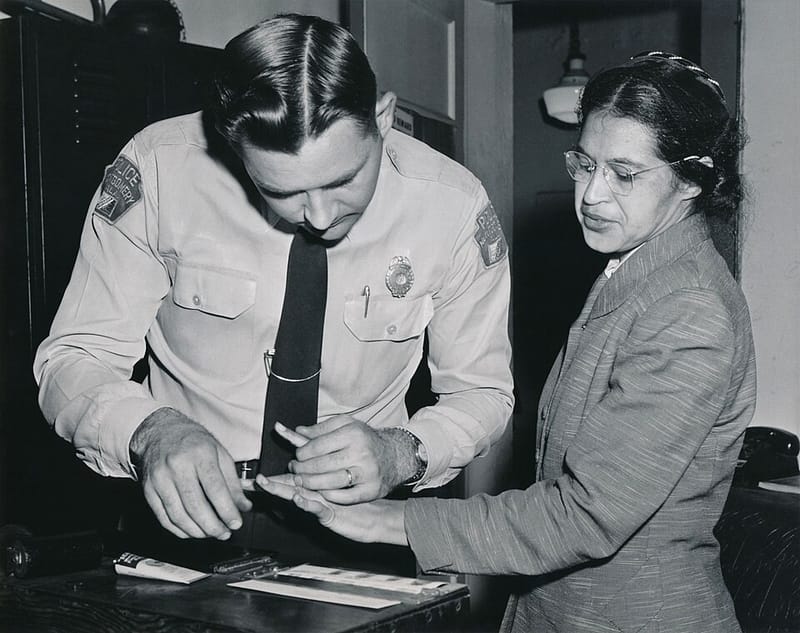
Sparked by the arrest of Rosa Parks on December 1, 1955, Black residents of Montgomery, Alabama, refused to ride the city’s segregated buses for thirteen months. Organized by the Montgomery Improvement Association under its young president, Martin Luther King Jr., the boycott ended in victory after the Supreme Court affirmed that bus segregation was unconstitutional. It showed the power of nonviolent mass protest and made King a national leader.
Key facts
- Date
- December 5, 1955 – December 20, 1956
- Location
- Montgomery, Alabama
- Dates
- December 5, 1955 – December 20, 1956
- Trigger
- Rosa Parks’s arrest, December 1, 1955
- Organizers
- Women’s Political Council (Jo Ann Robinson), E. D. Nixon, Montgomery Improvement Association
- Carpool
- About 300 cars
- Legal victory
- Browder v. Gayle: federal court ruling June 1956, affirmed by the Supreme Court November 1956
Why it matters
Montgomery proved that ordinary people acting together could defeat Jim Crow, and it introduced Martin Luther King Jr. to the nation.
Historical background
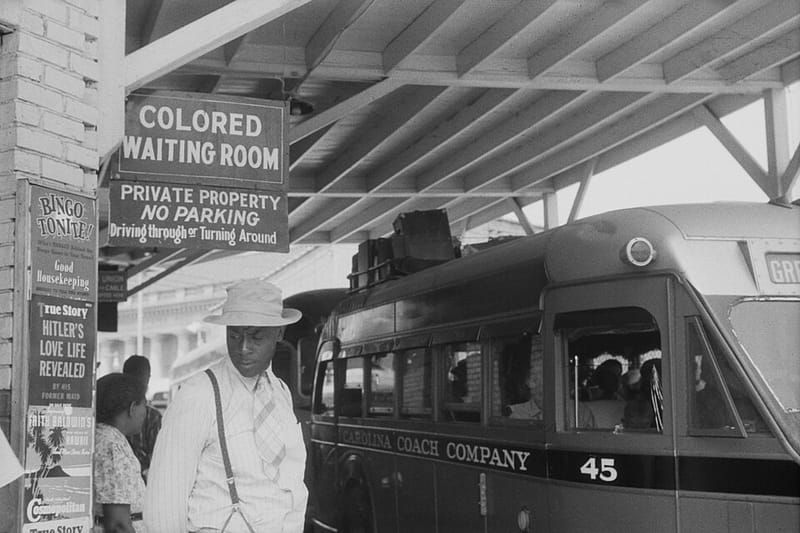
Montgomery’s buses forced Black riders to pay at the front, enter at the rear, and give up seats to white passengers. The Women’s Political Council, a group of Black professional women founded in 1946, had pressed the mayor for changes since 1954 and warned that a boycott was possible. In 1955 two teenagers, Claudette Colvin and Mary Louise Smith, were arrested for refusing to give up their seats, but neither arrest mobilized the community.
Causes and contributing factors
On December 1, 1955, Rosa Parks, a respected NAACP leader, was arrested for refusing to give up her seat to a white passenger. Jo Ann Robinson and the WPC printed leaflets calling for a one-day boycott on December 5, and E. D. Nixon gathered local ministers to support it.
What happened
On December 5, about 90 percent of Montgomery’s Black citizens stayed off the buses. That afternoon leaders formed the Montgomery Improvement Association and elected King, a 26-year-old pastor new to the city, as president. That night, at Holt Street Baptist Church, King told thousands, “If we are wrong, the Supreme Court of this nation is wrong. If we are wrong, the Constitution of the United States is wrong.”
The city refused the MIA’s modest demands. Boycotters walked or used an intricate carpool system of about 300 cars. Women such as Robinson and Johnnie Carr kept the committees running, and, as one organizer put it, “nameless cooks and maids” walked for a year. In early 1956 the homes of King and Nixon were bombed. Officials indicted more than 80 boycott leaders under a 1921 law against conspiracies that interfered with lawful business, and King was convicted. Bayard Rustin and others advised King on Gandhian nonviolence.
Immediate consequences
On June 5, 1956, a federal court ruled in Browder v. Gayle that bus segregation was unconstitutional; the Supreme Court affirmed in November. On December 20, 1956, when the order arrived, King called off the boycott, and the next morning he rode an integrated bus. King summed up its meaning: “it is more honorable to walk in dignity than ride in humiliation.”
Long-term significance
The boycott’s combination of mass nonviolent protest and Christian ethics became the model for challenging segregation across the South. In 1957 King and other ministers founded the Southern Christian Leadership Conference to spread it.
Study this entry
Check your understanding
Try answering in your own words, then open the answer.
1.What led to Montgomery Bus Boycott?Show answerHide
On December 1, 1955, Rosa Parks, a respected NAACP leader, was arrested for refusing to give up her seat to a white passenger. Jo Ann Robinson and the WPC printed leaflets calling for a one-day boycott on December 5, and E. D. Nixon gathered local ministers to support it.From “Causes and contributing factors” above.
2.What happened?Show answerHide
On December 5, about 90 percent of Montgomery’s Black citizens stayed off the buses. That afternoon leaders formed the Montgomery Improvement Association and elected King, a 26-year-old pastor new to the city, as president.From “What happened” above.
3.What were the immediate consequences?Show answerHide
On June 5, 1956, a federal court ruled in Browder v. Gayle that bus segregation was unconstitutional; the Supreme Court affirmed in November. On December 20, 1956, when the order arrived, King called off the boycott, and the next morning he rode an integrated bus.From “Immediate consequences” above.
4.Why does it still matter?Show answerHide
The boycott’s combination of mass nonviolent protest and Christian ethics became the model for challenging segregation across the South. In 1957 King and other ministers founded the Southern Christian Leadership Conference to spread it.From “Long-term significance” above.
Turn this entry into 10 flashcards (key facts, dates, and why it matters) and review them in Learn.
Related History
How this connects to the rest of the atlas.
People
Court cases

Sources
- 1.Montgomery Bus Boycott
The Martin Luther King, Jr. Research and Education Institute, Stanford University · Scholarly · cited for boycott dates, organizers, carpools, Browder v. Gayle
- 2.Parks, Rosa
The Martin Luther King, Jr. Research and Education Institute, Stanford University · Scholarly · cited for life, arrest, role in the boycott
- 3.Martin Luther King Jr. — Biographical
The Nobel Prize (Nobel Foundation) · Reference · cited for life, career, Nobel Prize, assassination
- 4.Southern Christian Leadership Conference (SCLC)
The Martin Luther King, Jr. Research and Education Institute, Stanford University · Scholarly · cited for SCLC founding
- 5.The American Yawp, “The Affluent Society”
The American Yawp (eds. Joseph Locke and Ben Wright; Stanford University Press) · Scholarly · cited for postwar civil rights, Brown, Till, Montgomery, Little Rock
Image credits
- Rosa Parks being fingerprinted by Deputy Sheriff D.H. Lackey after being arrested on February 22, 1956, during the Montgomery bus boycott, Gene Herrick for the Associated Press; restored by Adam Cuerden, 1956-02-22. Via Wikimedia Commons · Public domain · Source
Written for American History Atlas from the sources above. See how entries are researched.
Atlas by Alexander. More on Telegram.