EventRevolution and Independence
The Boston Tea Party
Colonists destroy East India Company tea in Boston Harbor
December 16, 1773Boston, Massachusetts
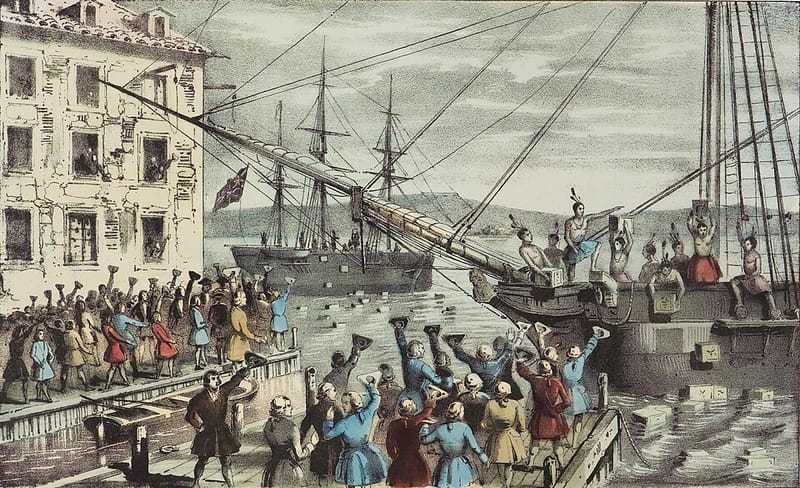
On the night of December 16, 1773, colonists disguised as Indians boarded East India Company ships in Boston Harbor and dumped the East India Company’s tea into the water. The protest targeted a law that gave the company a monopoly on tea shipments to the colonies. Britain’s harsh response — closing the port of Boston and curtailing self-government in Massachusetts — pushed the colonies toward united resistance and, within two years, war.
Key facts
- Date
- December 16, 1773
- Location
- Boston, Massachusetts
- Date
- December 16, 1773
- Target
- Tea shipped by the British East India Company under the Tea Act of 1773
- British response
- The Coercive Acts of 1774, called the Intolerable Acts by colonists
- Result
- Led to the First Continental Congress in September 1774
Why it matters
By destroying the tea and provoking Britain’s crackdown, the Boston protesters forced every colony to decide whether it stood with Massachusetts — and most did.
Historical background
After the Stamp Act was repealed, Parliament imposed the Townshend duties in 1767 on imported goods including tea. Colonial boycotts led Parliament to repeal most of them, but it kept the duty on tea as a symbol of its authority to tax. Many colonists drank smuggled Dutch tea instead.
Causes and contributing factors
In 1773 Parliament passed the Tea Act to rescue the struggling East India Company. It allowed the company to ship tea directly to the colonies free of the taxes paid by other importers. Although tea would be cheaper, the arrangement put colonial tea merchants out of business, and colonists saw it as a trick to make them accept the tea tax and Parliament’s right to impose it.
What happened
On December 16, 1773, colonists — some disguised as Indians — boarded the East India Company’s ships in Boston Harbor and threw crates of tea overboard. The protesters targeted the tea itself; the action was meant as a political statement against the company’s monopoly and Parliament’s tax.
Immediate consequences
British officials were determined to restore order. Parliament closed the port of Boston until the East India Company was compensated and passed further laws in 1774 placing Massachusetts under more direct royal control; General Thomas Gage was appointed military governor. Colonists called these the Intolerable Acts. Opinion was divided — some Bostonians offered to pay for the tea — but most colonists agreed on the need for a collective response, and the colonies sent delegates to the First Continental Congress.
Long-term significance
The Tea Party transformed a dispute over taxation into a confrontation over Parliament’s power to govern the colonies at all. The punishment of Massachusetts convinced many in other colonies that their own liberties were at risk, and it set in motion the events that led to Lexington and Concord.
Study this entry
Check your understanding
Try answering in your own words, then open the answer.
1.What led to the Boston Tea Party?Show answerHide
In 1773 Parliament passed the Tea Act to rescue the struggling East India Company. It allowed the company to ship tea directly to the colonies free of the taxes paid by other importers.From “Causes and contributing factors” above.
2.What happened?Show answerHide
On December 16, 1773, colonists — some disguised as Indians — boarded the East India Company’s ships in Boston Harbor and threw crates of tea overboard. The protesters targeted the tea itself; the action was meant as a political statement against the company’s monopoly and Parliament’s tax.From “What happened” above.
3.What were the immediate consequences?Show answerHide
British officials were determined to restore order. Parliament closed the port of Boston until the East India Company was compensated and passed further laws in 1774 placing Massachusetts under more direct royal control; General Thomas Gage was appointed military governor.From “Immediate consequences” above.
4.Why does it still matter?Show answerHide
The Tea Party transformed a dispute over taxation into a confrontation over Parliament’s power to govern the colonies at all. The punishment of Massachusetts convinced many in other colonies that their own liberties were at risk, and it set in motion the events that led to Lexington and Concord.From “Long-term significance” above.
Turn this entry into 8 flashcards (key facts, dates, and why it matters) and review them in Learn.
Related History
How this connects to the rest of the atlas.
People

Sources
- 1.Parliamentary Taxation of Colonies, International Trade, and the American Revolution, 1763–1775
U.S. Department of State, Office of the Historian · Institutional · cited for Sugar, Currency, Stamp, Townshend, Tea, and Intolerable Acts; colonial protest
- 2.Continental Congress, 1774–1781
U.S. Department of State, Office of the Historian · Institutional · cited for sessions, Articles of Association, Olive Branch Petition, wartime role
Image credits
- Boston Tea Party Currier colored, Nathaniel Currier, 1846. Via Wikimedia Commons · Public domain · Source
Written for American History Atlas from the sources above. See how entries are researched.
Atlas by Alexander. More on Telegram.