PersonThe Twenties and the Great Depression
Babe Ruth
The slugger who transformed baseball and became the most celebrated athlete of the 1920s
1895–1948
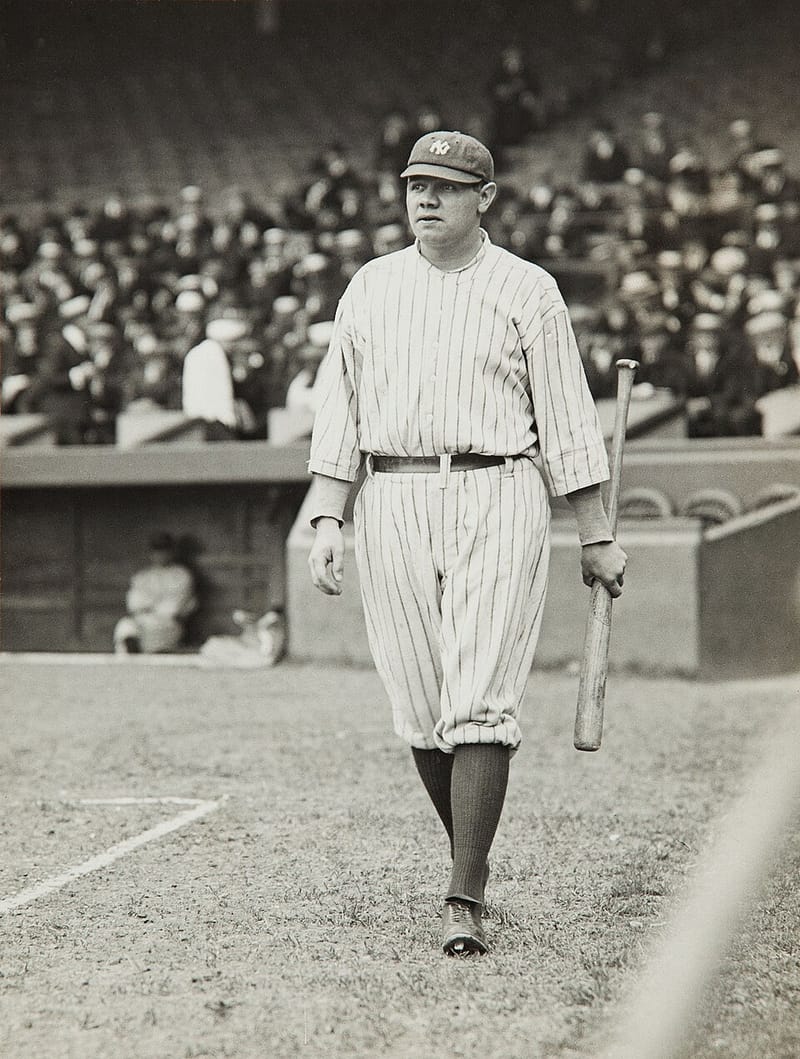
Babe Ruth was a troubled Baltimore boy raised in a reform school who became the most celebrated athlete of his time. A star pitcher for the Boston Red Sox, he was sold to the New York Yankees in 1920 and turned the home run from a rarity into the heart of the game — hitting 54 that year, more than all but one other major league team, and 60 in 1927. Larger than life on and off the field, he embodied the boisterous 1920s, filled ballparks across the country, and retired with 714 home runs.
Key facts
- Born
- February 6, 1895, Baltimore, Maryland
- Died
- August 16, 1948, New York City
- Roles
- Pitcher, Boston Red Sox (1914–1919); Outfielder, New York Yankees (1920–1934); Boston Braves (1935); One of the first five members of the Baseball Hall of Fame (1936)
- Career
- 714 home runs, a .342 batting average, and 2,214 runs batted in over 22 seasons
- Pitching
- 89 wins in six seasons with the Red Sox; a record 29⅔ straight scoreless World Series innings
- The sale
- Sold by the Red Sox to the Yankees for $100,000 after the 1919 season
- 60 in 1927
- His single-season home run record stood for 34 years
- World Series titles
- Seven: three with Boston, four with New York
- Hall of Fame
- One of the first five players elected, in 1936
Why it matters
Ruth changed how baseball was played — from a game of singles and stolen bases to one built on power — and, with the help of a ravenous press, made sports stardom a national obsession. He remains the standard against which American athletic greatness is measured.
Early life and context
George Herman Ruth was born on February 6, 1895, in Baltimore. His father ran a saloon and his mother was often ill, and by the age of six “Little George” was roaming the waterfront unsupervised, stealing, vandalizing, and drinking the dregs from beer glasses in his father’s bar. Shortly after he turned seven, his parents had a court declare him “incorrigible” and sent him to St. Mary’s Industrial School, a reform school on the city’s edge, where he lived for most of his youth. There Brother Matthias, “the father I needed and the greatest man I’ve ever known,” taught him to read and write — and to hit, by swatting fly balls the boy watched open-mouthed. Ruth copied his swing and even his quick, tiny running steps. In 1914 the owner of the minor-league Baltimore Orioles, Jack Dunn, signed him, and within five months sold him to the Boston Red Sox.
Major actions and achievements
Ruth was first a superb left-handed pitcher. He won 23 games in 1916 with a league-leading 1.75 earned run average, pitched all fourteen innings of a World Series victory, and helped Boston win three championships. But his hitting was too good to waste on the bench between starts, and in 1918 the Red Sox began playing him in the field; in 1919 he set a new record with 29 home runs. After that season the owner, Harry Frazee, sold him to the Yankees for $100,000 — probably the most famous transaction in baseball history.
In New York Ruth hit 54 home runs in 1920, more than fourteen of the other fifteen major league teams; no one else in the American League hit more than 19. In 1921 he hit 59, with 177 runs scored and 457 total bases, records that still stand for the modern era. Huge crowds followed him everywhere, and when the Yankees opened their own ballpark in the Bronx in 1923, Yankee Stadium was called “the House that Ruth Built.” In 1927, with Lou Gehrig beside him in the lineup, he hit 60 home runs. In the 1932 World Series at Wrigley Field he hit his legendary “called shot”: whether he really pointed to the center-field bleachers before homering there will never be known, and when asked, Ruth only smiled and said, “It’s in the papers, isn’t it?” He led the league in home runs twelve times and won seven World Series in all.
Beliefs and ideas
Ruth played for the crowd. “The fans would rather see me hit one homer to right than three doubles to left,” he said. He never forgot his own childhood: in Boston he invited busloads of orphans to his farm for picnics and ball games, sending each child home with a glove and an autographed ball.
Controversies, limits, and criticism
Ruth’s appetites were as famous as his home runs. He broke curfews, earned repeated suspensions, and in 1917 punched an umpire after a disputed walk. After the 1921 World Series the commissioner, Kenesaw Mountain Landis, suspended him for the first six weeks of the next season for an illegal barnstorming tour. In 1925 he reported to spring training at 256 pounds, needed surgery in April for what a sportswriter called “the bellyache heard ’round the world,” and had the worst season of his career — after which he began working out seriously. His first marriage fell apart; his estranged wife, Helen, died in a house fire in 1929, and he soon married Claire Hodgson.
Legacy
Ruth retired in 1935 after a partial season with the Boston Braves. In 1936 he was one of the first five players elected to the new Hall of Fame. In 1946 he was found to have cancer, though the newspapers never printed the word. On June 13, 1948, frail and shrunken, he returned to Yankee Stadium for its 25th anniversary as his number 3 was retired; he died on August 16, 1948, at fifty-three. His name became a byword for the best in any field, and “Ruthian” entered the language to mean colossal and prodigious. As one sportswriter put it, “It wasn’t that he hit more home runs than anybody else — he hit them better, higher, farther, with more theatrical timing and a more flamboyant flourish.”
Study this entry
Check your understanding
Try answering in your own words, then open the answer.
1.What shaped Babe Ruth early in life?Show answerHide
George Herman Ruth was born on February 6, 1895, in Baltimore. His father ran a saloon and his mother was often ill, and by the age of six “Little George” was roaming the waterfront unsupervised, stealing, vandalizing, and drinking the dregs from beer glasses in his father’s bar.From “Early life and context” above.
2.What were Babe Ruth’s major achievements?Show answerHide
Ruth was first a superb left-handed pitcher. He won 23 games in 1916 with a league-leading 1.75 earned run average, pitched all fourteen innings of a World Series victory, and helped Boston win three championships.From “Major actions and achievements” above.
3.What criticism or controversy surrounds Babe Ruth?Show answerHide
Ruth’s appetites were as famous as his home runs. He broke curfews, earned repeated suspensions, and in 1917 punched an umpire after a disputed walk.From “Controversies, limits, and criticism” above.
4.How is Babe Ruth remembered?Show answerHide
Ruth retired in 1935 after a partial season with the Boston Braves. In 1936 he was one of the first five players elected to the new Hall of Fame.From “Legacy” above.
Turn this entry into 12 flashcards (key facts, dates, and why it matters) and review them in Learn.
Related History
How this connects to the rest of the atlas.
Events
People

Sources
- 1.Babe Ruth
National Baseball Hall of Fame and Museum · Institutional · cited for career statistics, sale to the Yankees, records, quotations, death
- 2.Babe Ruth
Society for American Baseball Research (SABR BioProject, Allan Wood) · Scholarly · cited for childhood, St. Mary’s, Red Sox, Yankees, called shot, controversies, illness
Image credits
- Babe Ruth, Paul Thompson, 1920. Via Wikimedia Commons · Public domain · Source
Written for American History Atlas from the sources above. See how entries are researched.
Atlas by Alexander. More on Telegram.